
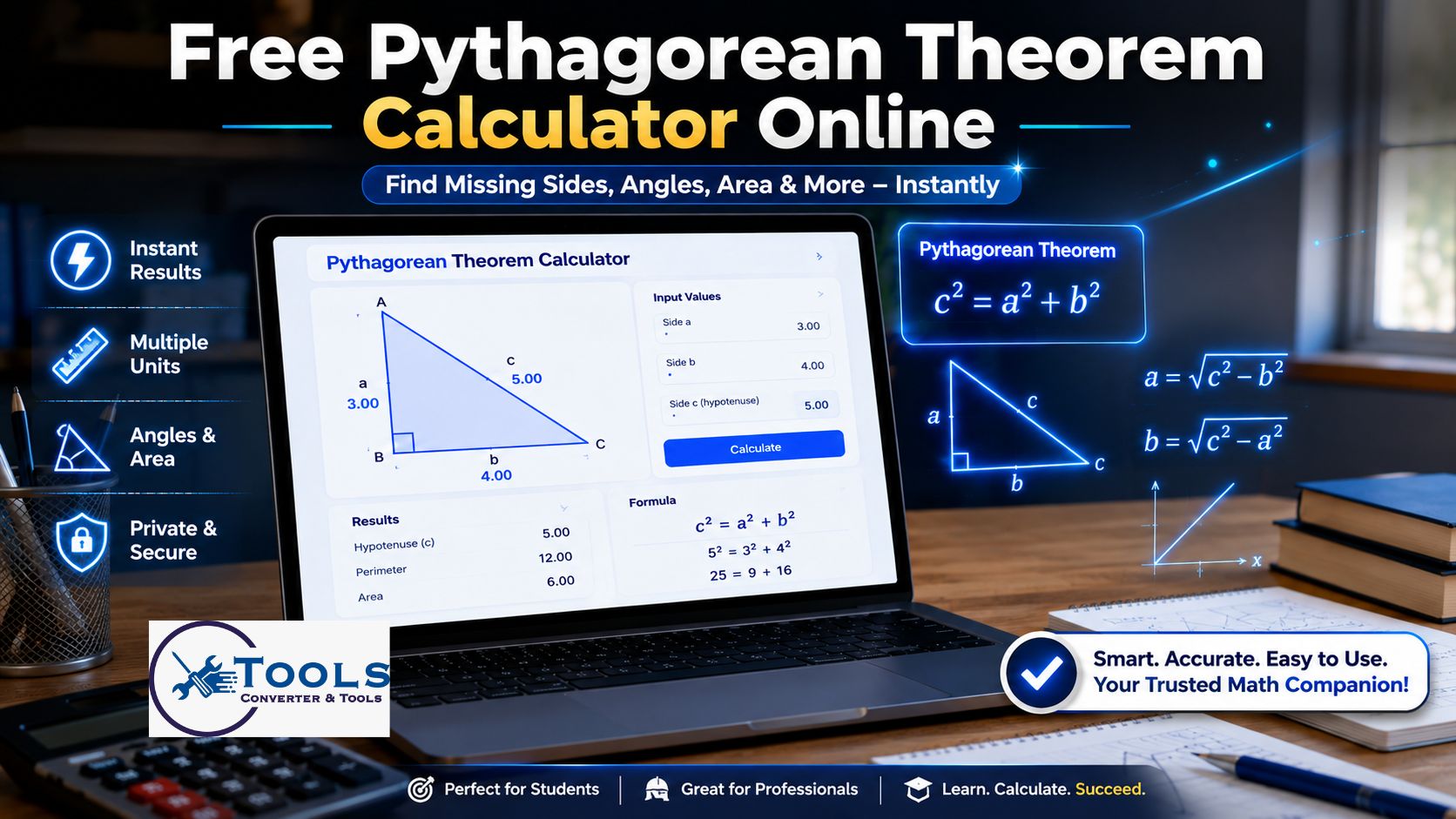
Pythagorean Theorem Calculator
Find a missing side of a right triangle using a² + b² = c².
Calculated result
Recent calculations
How to use this calculator
Select the missing side, enter the two known side lengths, and choose a unit. The calculator uses the Pythagorean theorem for right triangles and updates the answer instantly.
Tip: The hypotenuse is the longest side and sits opposite the right angle.
Free Pythagorean Theorem Calculator Online
Introduction to the Pythagorean Theorem Calculator
A pythagorean theorem calculator is a simple and useful tool designed to find the missing side of a right triangle. Instead of solving equations manually, users can enter the known side lengths and instantly receive accurate results.
This calculator is commonly used by students, teachers, engineers, architects, builders, and anyone working with measurements. It helps save time and reduces the risk of calculation errors.
Whether you need to find the hypotenuse or calculate one of the triangle's legs, this online calculator provides fast and reliable answers.
What Is the Pythagorean Theorem?
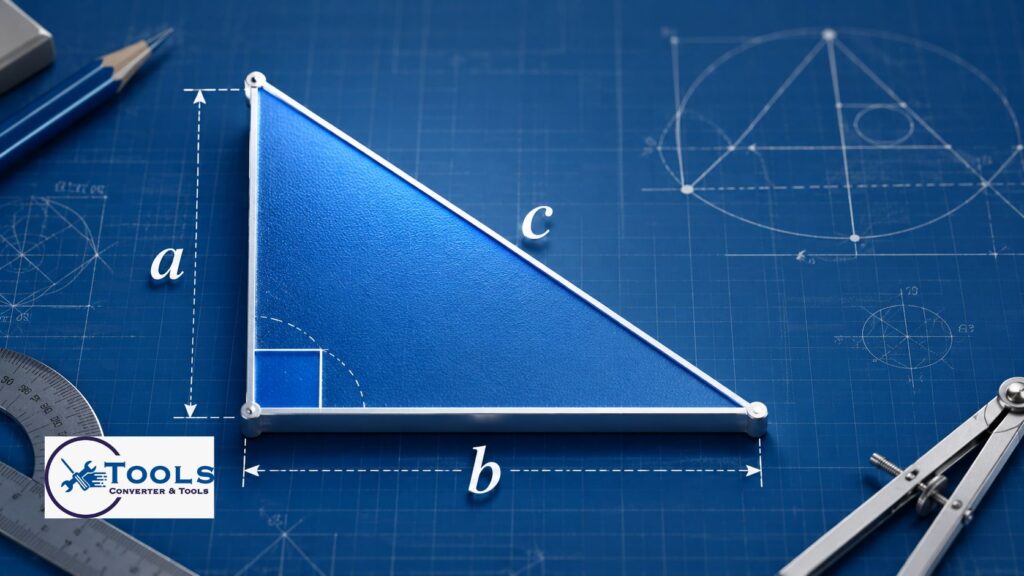
The Pythagorean theorem is one of the most important concepts in geometry. It describes the relationship between the three sides of a right triangle.
Understanding the Formula
The theorem is written as:
a² + b² = c²
Where:
- a = first leg of the triangle
- b = second leg of the triangle
- c = hypotenuse (the longest side)
According to the theorem, the sum of the squares of the two shorter sides equals the square of the hypotenuse.
When to Use the Theorem
The formula is used whenever a right triangle is involved. Common situations include:
- Geometry assignments
- Construction projects
- Home improvement work
- Engineering calculations
- Surveying measurements
- Navigation and mapping
Free Pythagorean Theorem Calculator
The online pythagorean theorem calculator makes solving right triangles much easier.
Instead of calculating squares and square roots by hand, users simply enter known values and let the calculator perform the work automatically.
Enter the Known Side Lengths
Begin by entering the two sides you already know. These values can be entered using different measurement units such as:
- Millimeters
- Centimeters
- Meters
- Kilometers
- Inches
- Feet
- Yards
- Miles
Select the Missing Side
Most calculators allow you to determine:
- The hypotenuse (c)
- Side a
- Side b
Simply choose the side you want to calculate.
View Instant Results
After clicking the calculate button, the tool immediately displays:
- Missing side length
- Triangle area
- Perimeter
- Angle measurements
- Side ratios
This provides a complete overview of the triangle.
How to Use the Pythagorean Theorem Calculator
Using the calculator is simple and requires only a few steps.
Step 1 – Choose the Value to Calculate
Select whether you want to find:
- Hypotenuse (c)
- Side a
- Side b
Step 2 – Enter the Known Measurements
Input the available side lengths into the calculator fields.
Make sure all values are positive numbers.
Step 3 – Select Your Preferred Unit
Choose the measurement unit that matches your project or assignment.
The calculator can work with various units while maintaining accuracy.
Step 4 – Click Calculate
Press the calculate button to process the information.
The result appears instantly.
Step 5 – Review the Results
The calculator will display:
- Missing side value
- Formula used
- Area
- Perimeter
- Angles
- Additional triangle information
Pythagorean Theorem Formula
The calculator uses standard mathematical formulas to find missing sides.
Finding the Hypotenuse
When both legs are known:
c² = a² + b²
To find c:
c = √(a² + b²)
The calculator squares both known sides, adds them together, and then calculates the square root.
Finding a Missing Leg
If the hypotenuse and one leg are known:
a = √(c² − b²)
or
b = √(c² − a²)
The calculator automatically performs the subtraction and square root operations.
Formula Explanation
The square of the longest side is always equal to the combined squares of the other two sides.
This relationship only applies to right triangles that contain a 90-degree angle.
Examples of Pythagorean Theorem Calculations
Examples make it easier to understand how the theorem works.
Example 1 – Finding the Hypotenuse
Given:
- a = 3
- b = 4
Formula:
c = √(3² + 4²)
c = √(9 + 16)
c = √25
c = 5
Result:
Hypotenuse = 5
Example 2 – Finding a Missing Leg
Given:
- c = 13
- b = 12
Formula:
a = √(13² − 12²)
a = √(169 − 144)
a = √25
a = 5
Result:
Side a = 5
Example 3 – Ladder Against a Wall
Imagine a ladder leaning against a wall.
Given:
- Ladder length = 10 feet
- Distance from wall = 6 feet
Formula:
Height = √(10² − 6²)
Height = √(100 − 36)
Height = √64
Height = 8 feet
Result:
The ladder reaches 8 feet up the wall.
Common Pythagorean Triples
Certain number combinations satisfy the theorem perfectly.
Popular Number Sets
Some common triples include:
- 3, 4, 5
- 5, 12, 13
- 8, 15, 17
- 7, 24, 25
- 9, 40, 41
Why These Triples Matter
These values allow quick calculations without needing a calculator.
They are widely used in construction, education, and geometry.
Applications of the Pythagorean Theorem
The theorem is useful in many real-world situations.
Geometry and Mathematics
Students frequently use it to solve triangle problems and understand geometric relationships.
Construction and Architecture
Builders use it to check right angles and verify measurements.
Surveying and Engineering
Surveyors and engineers rely on the theorem for accurate distance calculations.
Navigation and Mapping
The formula helps determine direct distances between locations.
Additional Triangle Measurements
Many modern calculators provide more than just side lengths.
Triangle Area
Area can be calculated using:
Area = ½ × base × height
The calculator automatically determines this value.
Triangle Perimeter
Perimeter is found by adding all three sides:
Perimeter = a + b + c
This helps estimate total boundary length.
Triangle Angles
Advanced calculators can calculate the two remaining angles in a right triangle.
This provides a more complete understanding of the shape.
Benefits of Using an Online Pythagorean Theorem Calculator
Online calculators offer several advantages.
Fast and Accurate Results
Calculations are completed instantly with minimal effort.
Easy for Beginners
Users do not need advanced mathematical knowledge.
Supports Multiple Units
The calculator can handle different measurement systems conveniently.
Reduces Calculation Errors
Automated calculations help eliminate common mistakes.
Common Mistakes to Avoid
Although the theorem is straightforward, some errors are common.
Using Non-Right Triangles
The formula only works with right triangles.
Entering Incorrect Measurements
Always double-check side lengths before calculating.
Confusing the Hypotenuse
The hypotenuse is always the longest side and sits opposite the right angle.
Using the wrong side can lead to incorrect answers.
Easy Cat Years to Human Years Calculator
Frequently Asked Questions
What is a pythagorean theorem calculator?
It is an online tool that calculates a missing side of a right triangle using the Pythagorean theorem formula.
Can this calculator find any missing side?
Yes. Most calculators can determine the hypotenuse or either leg when the required values are provided.
What is the hypotenuse?
The hypotenuse is the longest side of a right triangle and lies opposite the right angle.
Can I use different measurement units?
Yes. Most calculators support units such as meters, feet, inches, centimeters, and more.
Is the Pythagorean theorem only for right triangles?
Yes. The theorem only applies to triangles that contain a 90-degree angle.
Conclusion
The pythagorean theorem calculator is a practical tool for solving right-triangle problems quickly and accurately. Whether you are studying geometry, working on a construction project, or performing engineering calculations, this calculator simplifies the process.
By entering known side lengths, users can instantly find missing sides, calculate area and perimeter, and better understand the geometry of a right triangle. Its speed, accuracy, and ease of use make it an essential tool for anyone who regularly works with measurements and triangle calculations.
