

Dividend Calculator Pro
Calculate dividend income, yield, tax impact, reinvestment growth, and long-term portfolio projection.
Annual Dividend Income: $0.00
Total Shares: 0
Includes purchased shares and existing shares.
Dividend Yield: 0%
Annual dividend compared with the current share price.
Income Per Payment: $0.00
Estimated dividend received each payment period before tax.
After-Tax Annual Income: $0.00
Annual dividend income after the selected tax rate.
Total Dividends: $0.00
Total after-tax dividends over the full projection.
Final Portfolio Value: $0.00
Projected value after growth and optional reinvestment.
Final Shares: 0
Projected shares at the end of the selected period.
Estimated Total Return: 0%
Portfolio growth compared with the starting value.
| Year | Share Price | Dividend/Share | Annual Income | After Tax | Portfolio Value |
|---|
Free Dividend Calculator for Investors
A dividend calculator is a simple tool that helps investors estimate how much income they may earn from dividend-paying stocks. Instead of doing manual calculations, you can enter a few basic values such as investment amount, share price, dividend per share, payment frequency, tax rate, and reinvestment preference.
The calculator then shows useful results such as annual dividend income, dividend yield, income per payment, after-tax income, total dividends, and possible portfolio growth over time.
For investors who want quick answers, this tool is especially helpful. It can make dividend planning easier, whether you are building a passive income portfolio, comparing different stocks, or checking how reinvesting dividends may affect your long-term returns.
What Is a Dividend Calculator?
A dividend calculator is an online tool that estimates the dividend income you may receive from an investment. Dividends are payments made by some companies to shareholders, usually from company profits.
Many investors use dividends as a source of regular income. Some receive dividends monthly, while others receive them quarterly, semi-annually, or annually. Because payment schedules and dividend amounts can vary, a calculator helps make the numbers easier to understand.
The tool is useful for both beginners and experienced investors. It gives a quick estimate of how much income an investment may produce and how that income could grow over time.
Why Use a Dividend Calculator?
Dividend investing is not only about buying shares. Investors often need to know how much income they can expect, how often they may receive payments, and whether a stock offers a good dividend yield.
A dividend calculator helps answer these questions quickly. It can show whether a stock fits your income goals and whether reinvesting dividends may improve long-term results.
For example, if you invest in a stock that pays dividends every quarter, the calculator can estimate your annual income based on your number of shares. If you choose to reinvest dividends, it can also show how your share count and portfolio value may grow.
This saves time and reduces mistakes compared with manual calculations.
How the Dividend Calculator Works
The calculator uses your investment details to estimate dividend income and future portfolio value. You only need to enter the values related to your stock investment.
The main inputs usually include investment amount, share price, dividend per share, payment frequency, tax rate, growth rate, and projection years.
Once these values are entered, the calculator performs the math automatically. It calculates how many shares you own, how much dividend income you may receive, and what your investment could look like after several years.
How to Use the Dividend Calculator
Using the dividend calculator is simple. You do not need advanced investing knowledge. You only need basic stock and dividend details.
Enter Your Investment Amount
Start by entering the amount of money you plan to invest. For example, if you want to invest $10,000 in a dividend-paying stock, enter 10000 in the investment field.
This value helps the calculator estimate how many shares you can buy based on the current share price.
Add the Current Share Price
Next, enter the current market price of one share. If the stock price is $50, enter 50.
The calculator divides your investment amount by the share price to estimate the number of shares you can purchase.
Include Existing Shares
If you already own shares, you can enter them as existing shares. This is useful if you are calculating income from a current portfolio instead of a new investment.
For example, if you already own 25 shares, enter 25. The calculator will add them to any new shares purchased with your investment amount.
Enter Dividend Per Share
Dividend per share is the amount paid for each share during one payment period. For example, if a company pays $0.60 per share every quarter, enter 0.60.
The calculator uses this figure with the payment frequency to calculate annual dividend income.
Select Dividend Frequency
Dividend frequency means how often the company pays dividends. Common options include monthly, quarterly, semi-annual, and annual.
If a company pays four times a year, choose quarterly. If it pays once a year, choose annual.
This helps the calculator estimate yearly income correctly.
Add Growth and Tax Details
Some dividend calculators allow you to enter annual dividend growth and stock price growth. These values help estimate future results.
You can also enter a dividend tax rate. This shows how much dividend income may remain after tax.
For example, if your tax rate is 15%, the calculator will estimate your after-tax dividend income.
Choose Reinvestment Option
Dividend reinvestment means using dividend payments to buy more shares instead of taking the income as cash.
If you turn on reinvestment, the calculator estimates how many extra shares you may gain over time. This can increase future dividend income because more shares can generate more dividends.
Dividend Calculator Formula
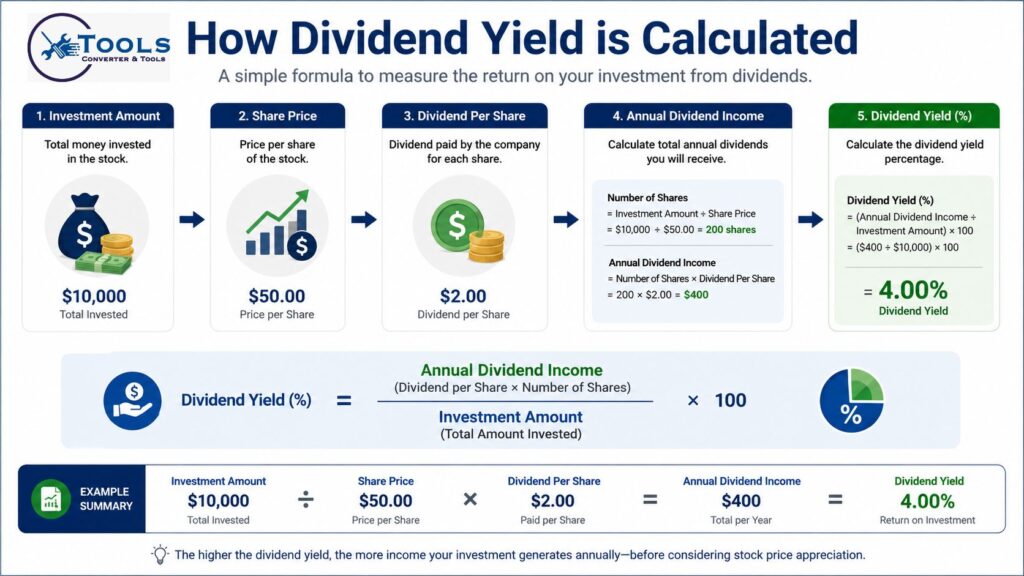
A dividend calculator uses several simple formulas to estimate income and returns. These formulas are helpful if you want to understand how the tool works.
Number of Shares Formula
The first step is calculating how many shares you own.
Number of Shares = Investment Amount ÷ Share Price
Example:
Investment amount: $10,000
Share price: $50
Number of Shares = 10,000 ÷ 50 = 200 shares
If you already own shares, they are added to the total.
Annual Dividend Income Formula
Annual dividend income shows how much income you may receive in one year before tax.
Annual Dividend Income = Shares × Dividend Per Share × Payment Frequency
Example:
Shares: 200
Dividend per share: $0.60
Frequency: 4 payments per year
Annual Dividend Income = 200 × 0.60 × 4 = $480
This means the investment may generate $480 in annual dividend income before tax.
Dividend Yield Formula
Dividend yield shows the dividend return compared with the stock price.
Dividend Yield = Annual Dividend Per Share ÷ Share Price × 100
Example:
Dividend per share: $0.60 quarterly
Annual dividend per share: $2.40
Share price: $50
Dividend Yield = 2.40 ÷ 50 × 100 = 4.8%
A 4.8% dividend yield means the annual dividend equals 4.8% of the current share price.
After-Tax Dividend Formula
If tax applies, after-tax dividend income can be calculated like this:
After-Tax Income = Annual Dividend Income × (1 – Tax Rate)
Example:
Annual dividend income: $480
Tax rate: 15%
After-Tax Income = 480 × (1 – 0.15) = $408
This means the investor may keep $408 after tax.
Practical Dividend Calculation Examples
Here are a few simple examples to show how the dividend calculator can be used in real situations.
Example 1: Quarterly Dividend Income
Suppose you invest $5,000 in a stock priced at $25 per share. The company pays $0.30 per share every quarter.
Investment amount: $5,000
Share price: $25
Shares: 200
Dividend per share: $0.30
Frequency: Quarterly
Annual dividend income:
200 × 0.30 × 4 = $240
In this example, the investor may earn $240 per year before tax.
Example 2: Monthly Dividend Income
Now suppose you invest $12,000 in a stock priced at $40 per share. The stock pays $0.20 per share every month.
Investment amount: $12,000
Share price: $40
Shares: 300
Dividend per share: $0.20
Frequency: Monthly
Annual dividend income:
300 × 0.20 × 12 = $720
This means the investor may receive around $60 per month before tax.
Example 3: After-Tax Dividend Income
Assume your annual dividend income is $1,000 and your dividend tax rate is 20%.
After-tax income:
1,000 × (1 – 0.20) = $800
This shows why tax settings are useful. The gross dividend amount and the amount you actually keep can be different.
Example 4: Dividend Reinvestment
Suppose you earn $500 in after-tax dividends and reinvest that money into a stock priced at $50.
Extra shares purchased:
500 ÷ 50 = 10 shares
Those 10 new shares may generate more dividends in the future. Over several years, reinvestment can help increase both share count and dividend income.
What Results Can You Get?
A dividend calculator can provide several useful results in one place.
It can show your total shares, annual dividend income, income per payment, dividend yield, after-tax income, total projected dividends, final share count, and possible portfolio value.
These results help investors understand both short-term income and long-term growth potential.
For example, income per payment is useful if you want to know how much you may receive each month or quarter. Final portfolio value is useful if you want to estimate long-term investment growth.
Benefits of Using This Tool
The main benefit of using a dividend calculator is speed. You can calculate dividend income in seconds without using spreadsheets or manual formulas.
It also improves accuracy. Small mistakes in dividend frequency or tax calculations can lead to wrong estimates. A calculator helps reduce those errors.
Another benefit is comparison. You can test different stocks, dividend amounts, tax rates, and reinvestment settings to see which option fits your goals better.
This makes the tool useful for planning passive income, retirement income, and long-term portfolio growth.
Dividend Yield vs Dividend Income
Dividend yield and dividend income are related, but they are not the same.
Dividend income is the actual amount of money you may receive from your shares. Dividend yield is the percentage return based on the stock price.
For example, a stock may pay $2 per share annually and trade at $50. Its dividend yield is 4%.
If you own 100 shares, your annual dividend income would be $200.
Both numbers matter. Yield helps compare stocks, while income shows the actual cash amount you may receive.
Things to Keep in Mind
A dividend calculator gives estimates, not guaranteed results. Companies can increase, reduce, pause, or cancel dividends.
Stock prices can also change over time. If the share price rises or falls, dividend yield and reinvestment results may change.
Taxes can vary depending on your country, account type, and personal situation. The calculator can estimate tax impact, but it should not be treated as financial or tax advice.
Use the results as a planning guide, not as a guaranteed outcome.
Who Can Use a Dividend Calculator?
This tool is useful for many types of investors.
Beginners can use it to understand how dividend income works. Long-term investors can use it to project future income. Income-focused investors can use it to estimate monthly or yearly cash flow.
It is also helpful for people comparing dividend stocks. By changing the share price, dividend amount, and frequency, users can quickly compare different investment options.
Accurate Cubic Feet Calculator for Any Dimension
FAQ
What is a dividend calculator?
A dividend calculator is a tool that estimates dividend income based on your investment amount, share price, dividend per share, and payment frequency.
How do I calculate dividend income?
Dividend income is calculated by multiplying the number of shares by the dividend per share and the number of payments per year.
What is dividend yield?
Dividend yield is the annual dividend per share divided by the current share price, shown as a percentage.
Can I calculate after-tax dividends?
Yes. If the calculator includes a tax field, you can enter your dividend tax rate to estimate after-tax dividend income.
Does reinvesting dividends increase returns?
Reinvesting dividends can increase your share count over time, which may lead to higher future dividend income if dividends continue.
