
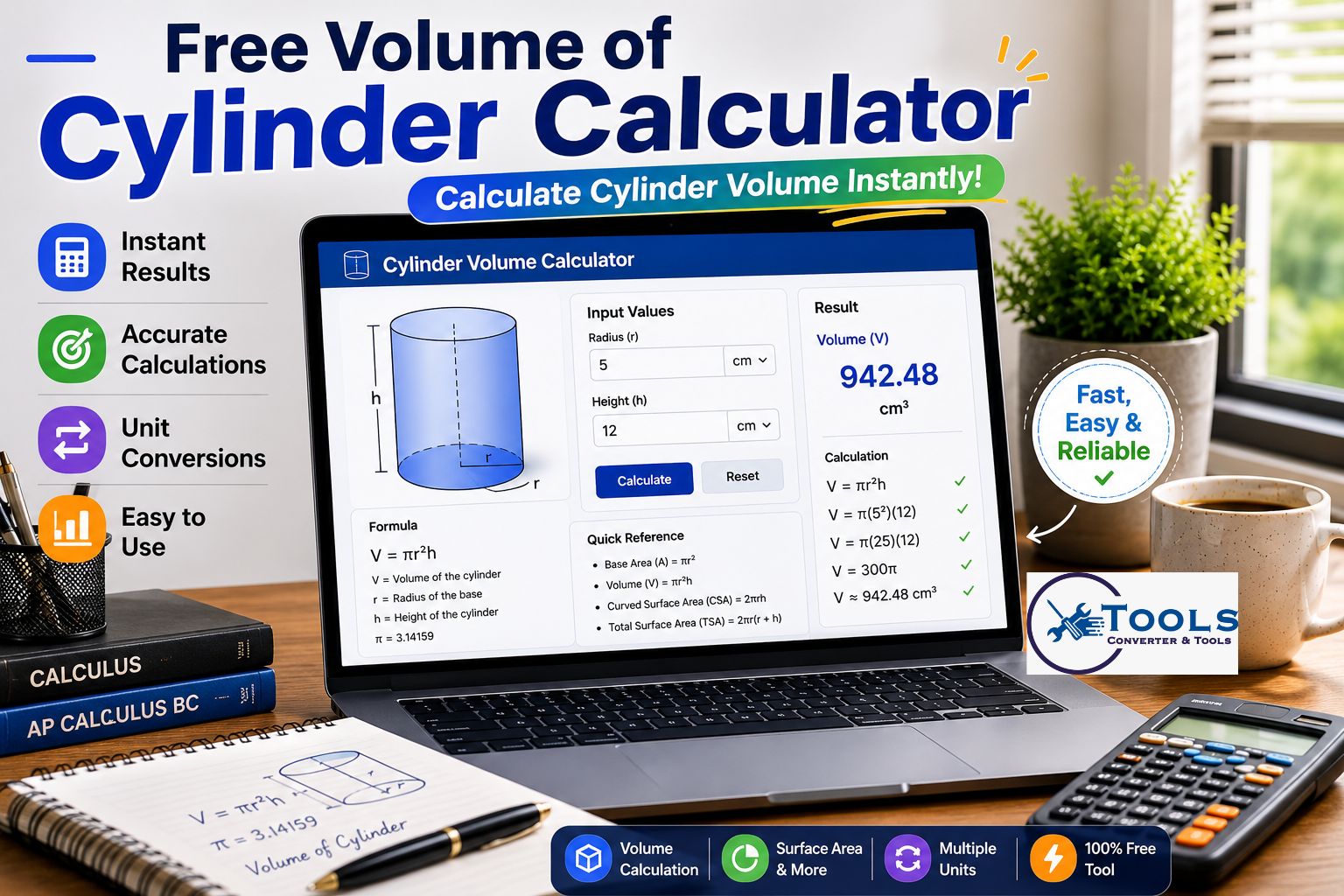
Volume of Cylinder Calculator Pro
Calculate cylinder volume, surface area, base area, and unit conversions instantly.
Volume: 0 cm³
Base Area: 0 cm²
Curved Surface Area: 0 cm²
Total Surface Area: 0 cm²
Diameter: 0 cm
Formula: V = πr²h
Volume Conversions
Volume of Cylinder Calculator with Instant Results
A volume of cylinder calculator is a simple online tool that helps you find the volume of a cylinder in seconds. Instead of doing the full calculation by hand, you only need to enter the radius or diameter, add the height, choose the unit, and get the answer instantly.
This tool is useful for students, teachers, engineers, builders, designers, mechanics, and anyone who works with round containers, pipes, tanks, tubes, or cylindrical objects. Whether you are solving a math problem or estimating the capacity of a real object, a calculator makes the process faster and easier.
Cylinder volume is measured in cubic units, such as cubic centimeters, cubic meters, cubic inches, or cubic feet. In some cases, the result can also be converted into liters or milliliters, especially when measuring liquid capacity.
What Is a Volume of Cylinder Calculator?
A volume of cylinder calculator is a digital tool designed to calculate how much space is inside a cylinder. A cylinder is a three-dimensional shape with two equal circular bases and one curved side.
Common examples include:
- Water tanks
- Pipes
- Cans
- Drums
- Cylindrical jars
- Fuel tanks
- Tubes
- Concrete columns
The calculator uses the standard cylinder volume formula and gives results instantly. Many tools also show related values, such as base area, curved surface area, total surface area, diameter, and unit conversions.
This makes it more helpful than a basic manual calculation because users can get several useful measurements at the same time.
Why Use This Calculator?
Manual calculations can take time, especially if you need to convert units or work with decimal values. A volume of cylinder calculator reduces the chance of mistakes and saves effort.
It is especially useful when you need a quick answer for practical work. For example, if you want to know how much water a cylindrical tank can hold, you can enter the tank’s radius and height, then convert the result into liters.
The tool is also helpful for learning. Students can use it to check homework answers, understand the formula, and compare results with different measurements.
How the Calculator Works
The calculator works by using the radius and height of the cylinder. If you enter the diameter instead of the radius, the tool first divides the diameter by 2 to get the radius.
After that, it applies the cylinder volume formula:
V = πr²h
This formula calculates the space inside the cylinder. The calculator then displays the final volume in the selected unit. If unit conversion is included, it can also show the answer in other common volume units.
Volume of Cylinder Formula
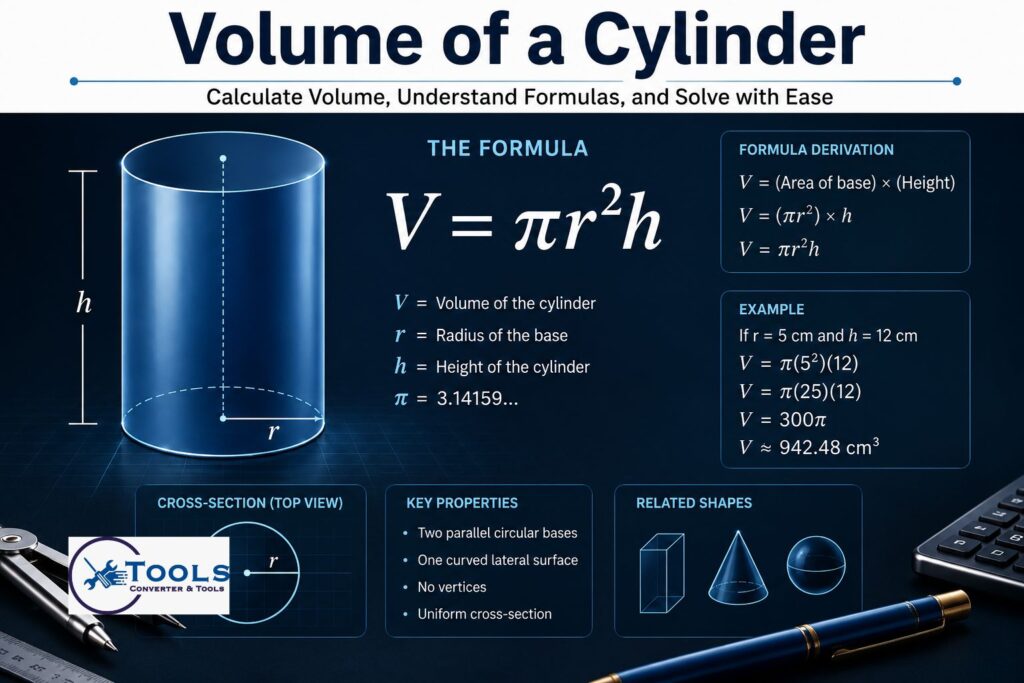
The standard formula for cylinder volume is:
V = πr²h
Here is what each part means:
V means volume
π means pi, usually written as 3.14159
r means radius of the circular base
h means height of the cylinder
The radius is the distance from the center of the circular base to its edge. The height is the straight distance from one circular base to the other.
If you only know the diameter, use this formula first:
Radius = Diameter ÷ 2
Then place the radius into the main volume formula.
How to Use the Volume of Cylinder Calculator
Using the calculator is simple. You do not need advanced math knowledge. Just follow a few basic steps.
Enter Radius or Diameter
First, choose whether you want to enter the radius or diameter. If you already know the radius, select radius. If you know the full width of the circular base, select diameter.
Enter the Height
Next, enter the height of the cylinder. Make sure the height uses the same unit as the radius or diameter unless the tool allows mixed units.
Select the Unit
Choose the measurement unit, such as centimeters, meters, inches, or feet. The selected unit affects the final volume result.
For example, if you enter radius and height in centimeters, the main result will usually be shown in cubic centimeters.
Click Calculate
After entering the values, click the calculate button. The tool will show the cylinder volume instantly.
Review the Results
A good calculator may also show extra details, such as:
- Base area
- Curved surface area
- Total surface area
- Diameter
- Formula used
- Volume conversions
These extra results help users understand the calculation better.
Supported Measurement Units
A volume of cylinder calculator commonly supports both metric and imperial units. This makes it useful for users in different countries and industries.
Metric Units
Metric units are commonly used in education, science, construction, and engineering.
Common metric inputs include:
- Millimeters
- Centimeters
- Meters
Common metric volume outputs include:
- Cubic millimeters
- Cubic centimeters
- Cubic meters
- Milliliters
- Liters
Imperial Units
Imperial units are often used in the United States and in some construction or manufacturing fields.
Common imperial inputs include:
- Inches
- Feet
Common imperial volume outputs include:
- Cubic inches
- Cubic feet
Having both unit systems in one tool makes the calculator more flexible and practical.
Practical Examples
Examples make the formula easier to understand. Here are a few simple cylinder volume calculations.
Example 1: Cylinder with Radius and Height
Suppose a cylinder has:
Radius = 5 cm
Height = 10 cm
Formula:
V = πr²h
Calculation:
V = 3.14159 × 5² × 10
V = 3.14159 × 25 × 10
V = 785.3975 cm³
So, the volume is about 785.4 cubic centimeters.
Example 2: Cylinder with Diameter
Suppose a cylinder has:
Diameter = 12 inches
Height = 20 inches
First, find the radius:
Radius = 12 ÷ 2 = 6 inches
Now use the formula:
V = πr²h
Calculation:
V = 3.14159 × 6² × 20
V = 3.14159 × 36 × 20
V = 2261.94 in³
So, the volume is about 2261.94 cubic inches.
Example 3: Water Tank Volume
Suppose a water tank has:
Radius = 1 meter
Height = 2 meters
Calculation:
V = 3.14159 × 1² × 2
V = 6.28318 m³
Since 1 cubic meter equals 1000 liters:
6.28318 m³ = 6283.18 liters
So, the tank can hold about 6283 liters of water.
Common Uses of Cylinder Volume Calculation
Cylinder volume is not only a classroom topic. It is used in many real-world situations.
Water Tanks
Water tanks are often cylindrical. Knowing the volume helps estimate how much water the tank can store.
Pipes and Tubes
Pipes are cylindrical shapes. Volume calculations help estimate flow capacity or internal space.
Fuel Containers
Many fuel tanks and drums are cylinder-shaped. Volume calculations help measure storage capacity.
Construction Columns
Cylindrical concrete columns require volume calculations to estimate material needs.
Manufacturing
Factories often work with cylindrical parts, containers, and machine components. Accurate volume measurements help reduce waste and improve planning.
Volume vs Surface Area
Volume and surface area are related, but they are not the same.
Volume measures the space inside a cylinder. It is written in cubic units, such as cm³ or ft³.
Surface area measures the outside area of the cylinder. It is written in square units, such as cm² or ft².
If you want to know how much liquid a tank can hold, you need volume. If you want to know how much material is needed to cover the outside of a cylinder, you need surface area.
A good volume of cylinder calculator may show both values, which is useful for practical projects.
Common Mistakes to Avoid
Even with a calculator, it is important to enter the correct values.
Confusing Radius and Diameter
Radius is half of the diameter. If you enter the diameter as the radius, your answer will be much larger than it should be.
Mixing Units
Do not enter radius in centimeters and height in meters unless the calculator supports mixed units. Always keep units consistent.
Using Negative Values
Cylinder dimensions must be positive numbers. A radius, diameter, or height cannot be negative.
Rounding Too Early
If you are calculating manually, avoid rounding numbers too early. This can make the final result less accurate.
Benefits of an Online Calculator
An online volume of cylinder calculator offers several benefits.
It provides quick results, reduces calculation errors, and supports different measurement units. It also helps users understand the formula by showing related values and conversions.
For students, it can be a learning aid. For professionals, it can save time during planning and measurement tasks. For everyday users, it makes simple capacity estimates much easier.
Free AP Calc BC Score Calculator and Score Predictor
FAQ
What is the formula for cylinder volume?
The formula is V = πr²h. In this formula, r is the radius and h is the height of the cylinder.
Can I use diameter instead of radius?
Yes. If you know the diameter, divide it by 2 to get the radius. Then use the radius in the volume formula.
What unit is cylinder volume measured in?
Cylinder volume is measured in cubic units, such as cm³, m³, in³, or ft³. It can also be converted into liters or milliliters.
Is this calculator useful for water tanks?
Yes. A volume of cylinder calculator is very useful for estimating the capacity of cylindrical water tanks.
Why is my result in cubic units?
Volume measures three-dimensional space, so the result is always shown in cubic units, such as cubic centimeters or cubic feet.
Conclusion
A volume of cylinder calculator is a fast and practical tool for finding the space inside any cylinder. It is useful for math problems, construction work, tank capacity estimates, pipe measurements, and many other real-life tasks.
By entering the radius or diameter, height, and unit, you can get an instant and accurate result without doing the full calculation manually. The tool also helps with unit conversions, surface area values, and formula understanding.
For anyone who needs quick cylinder volume calculations, this calculator offers a simple, clear, and reliable solution.
