
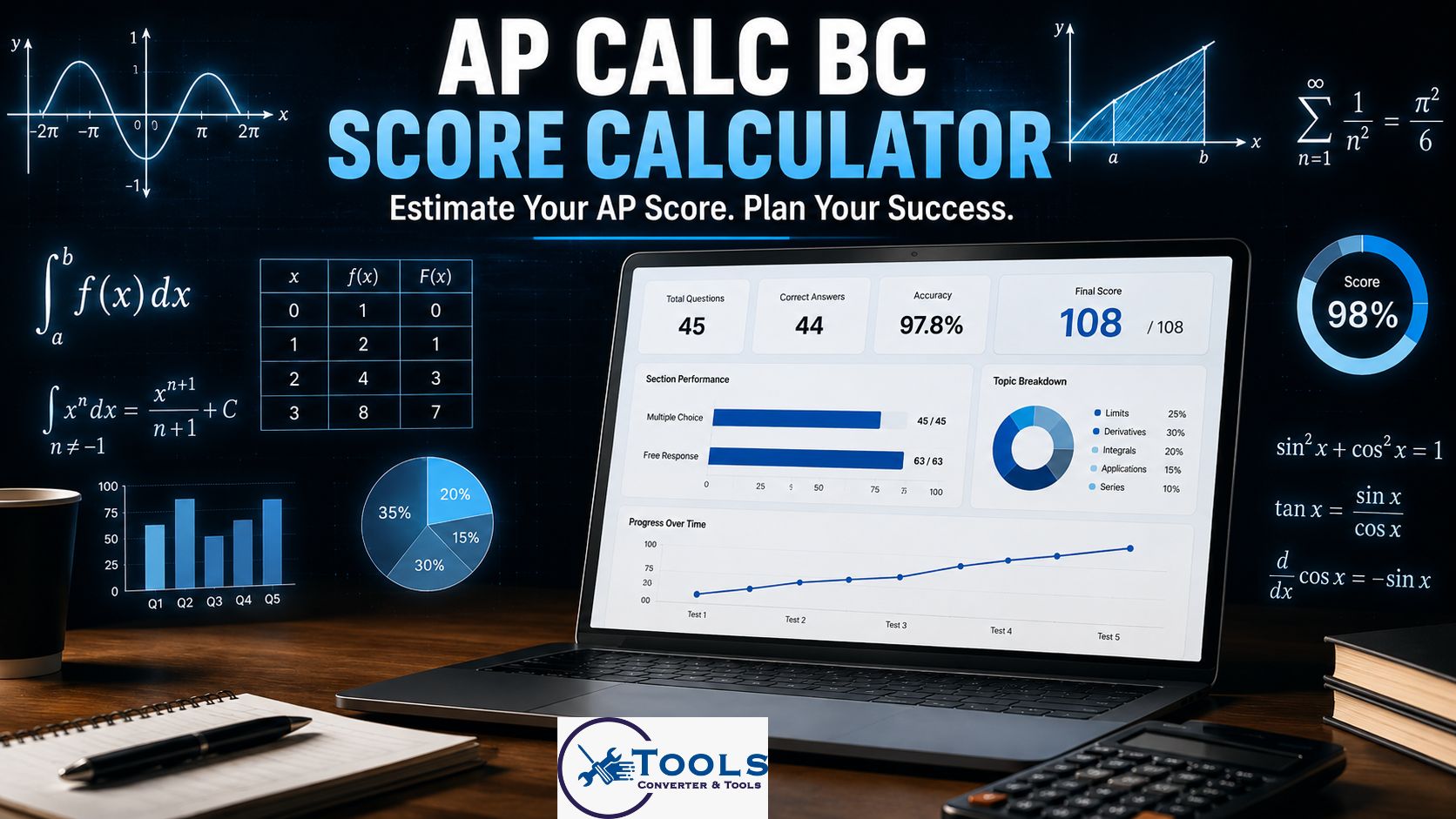
AP Calc BC Score Calculator
Estimate your AP Calculus BC score, AB subscore, composite score, percentage, and college credit possibility.
Estimated AP Score: 5 Excellent
Composite Score 0 / 108
Estimated Percent 0%
MCQ Weighted Points 0 / 54
FRQ Weighted Points 0 / 54
Estimated AB Subscore Not calculated
Pass Status Not calculated
Score Range Not calculated
College Credit Possibility Not calculated
GPS Location Not added yet
Nearest Result Map Waiting for GPS
This calculator gives an estimate only. Official AP scores are set by the College Board and can change by exam year.
Free AP Calc BC Score Calculator and Score Predictor
The ap calc bc score calculator is a simple online tool that helps students estimate their AP Calculus BC exam score before official results are released. Instead of guessing how your Multiple Choice and Free Response performance may translate into an AP score, this calculator gives you a quick score prediction based on your entered results.
AP Calculus BC is one of the more advanced math exams offered in the AP program. Because the exam includes both calculator and non-calculator sections, many students find it hard to understand how their raw performance becomes a final score from 1 to 5. That is where a score calculator becomes useful.
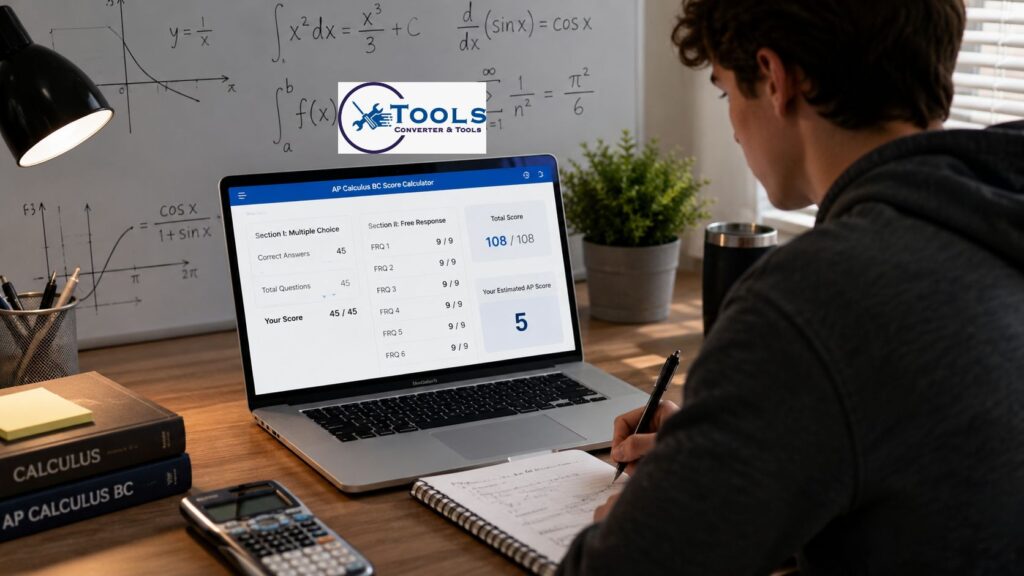
With this tool, you can enter your estimated Multiple Choice correct answers, Free Response points, and scoring curve option. The calculator then gives you an estimated composite score, AP score, percentage, and possible AB subscore.
What Is the AP Calc BC Score Calculator?
The ap calc bc score calculator is designed to estimate your likely AP Calculus BC score using common score prediction methods. It is not an official College Board calculator, but it can help you understand where you may stand.
The tool works by converting your MCQ and FRQ performance into weighted points. These points are then combined into a composite score. Based on that total, the calculator predicts whether your result may fall near a 1, 2, 3, 4, or 5.
For students, this is helpful because official AP scores are usually released weeks after the exam. A calculator gives an early estimate, which can reduce uncertainty and help with planning.
Why Use This Tool?
Students use an AP Calc BC score predictor for several practical reasons. Some want to know whether they are likely to earn college credit. Others want to check how close they are to a higher score. Many students also use it while practicing with past exam questions.
This tool is useful for:
- Estimating your AP score quickly
- Understanding your composite score
- Checking your MCQ and FRQ balance
- Predicting your AB subscore
- Planning future study goals
- Reviewing practice exam results
The calculator is especially helpful during exam preparation because it shows how different sections affect your final result.
How the AP Calculus BC Exam Works
AP Calculus BC tests advanced calculus topics. It includes limits, derivatives, integrals, sequences, series, parametric equations, polar functions, and vector-valued functions.
The exam has two main parts:
Multiple Choice Section
The Multiple Choice section includes questions that test speed, accuracy, and conceptual understanding. Some questions allow a calculator, while others do not.
In many score calculators, the MCQ section is entered as the number of correct answers out of 45. Since there is no penalty for wrong answers, only correct responses matter.
Free Response Section
The Free Response section includes written problems where students must show work, explain reasoning, and apply calculus methods. These questions are usually scored with points based on correct steps and final answers.
Most AP Calc BC score calculators use a Free Response total out of 54 points.
How to Use the AP Calc BC Score Calculator
Using the ap calc bc score calculator is simple. You only need your estimated MCQ correct answers and FRQ points.
Enter Your MCQ Correct Answers
First, enter the number of Multiple Choice questions you believe you answered correctly. For example, if you got 35 questions correct out of 45, enter 35.
Try to be realistic when entering this number. If you are using the calculator after a practice test, count only the answers you marked correctly.
Enter Your FRQ Points
Next, enter your estimated Free Response score. This is usually based on points earned across all FRQ questions.
For example, if the total FRQ score is 54 and you estimate that you earned 38 points, enter 38.
Choose a Scoring Curve
Some calculators allow you to choose a standard, strict, or lenient curve. This is useful because AP score cutoffs may vary slightly from year to year.
A standard curve gives a balanced estimate. A strict curve gives a more conservative result. A lenient curve may show what your score could look like if the exam curve is more forgiving.
Calculate Your Score
After entering your values, click the calculate button. The tool will show your estimated AP score, composite score, percentage, AB subscore estimate, and credit possibility.
AP Calc BC Score Formula
The calculator uses a simple weighted scoring method. Since AP Calculus BC includes MCQ and FRQ sections, both parts are converted into a combined composite score.
MCQ Weighted Score Formula
The MCQ section is commonly converted into weighted points.
MCQ Weighted Points = (MCQ Correct ÷ 45) × 54
For example, if you answered 36 MCQ questions correctly:
(36 ÷ 45) × 54 = 43.2
So, your MCQ weighted score would be 43.2 out of 54.
FRQ Weighted Score Formula
The FRQ score is usually entered directly as points out of 54.
For example, if you earned 40 FRQ points, your FRQ weighted score is:
40 out of 54
Composite Score Formula
The composite score combines both weighted sections.
Composite Score = MCQ Weighted Points + FRQ Points
For example:
43.2 + 40 = 83.2
This means your composite score would be 83.2 out of 108.
AP Score Conversion
After the composite score is calculated, the tool estimates your AP score from 1 to 5.
A common estimated scale may look like this:
- 5: Excellent performance
- 4: Strong performance
- 3: Qualified performance
- 2: Needs improvement
- 1: Low performance
The exact score cutoffs can change depending on the exam year and difficulty level. That is why the result should be treated as an estimate, not an official score.
Practical Score Examples
Here are a few examples to show how the ap calc bc score calculator works.
Example 1: Strong Performance
Suppose a student gets:
- MCQ Correct: 40 out of 45
- FRQ Points: 44 out of 54
MCQ weighted score:
(40 ÷ 45) × 54 = 48
Composite score:
48 + 44 = 92
This would likely predict an AP score of 5. The student performed strongly in both sections.
Example 2: Average Performance
Suppose a student gets:
- MCQ Correct: 30 out of 45
- FRQ Points: 32 out of 54
MCQ weighted score:
(30 ÷ 45) × 54 = 36
Composite score:
36 + 32 = 68
This may predict a score around 4, depending on the curve. If the curve is strict, the result could be closer to a high 3.
Example 3: Borderline Passing Score
Suppose a student gets:
- MCQ Correct: 22 out of 45
- FRQ Points: 27 out of 54
MCQ weighted score:
(22 ÷ 45) × 54 = 26.4
Composite score:
26.4 + 27 = 53.4
This may fall near a 3, depending on the scoring curve. It shows why both MCQ and FRQ performance matter.
What Is the AB Subscore?
AP Calculus BC also includes an AB subscore. This subscore reflects performance on topics that overlap with AP Calculus AB.
The AB subscore can be useful because some colleges may use it for placement or credit decisions. A strong AB subscore can show that you understand core calculus topics, even if your BC-specific performance is weaker.
A calculator can estimate this subscore based on your overall score and your selected AB topic performance. However, this is only an estimate.
College Credit Possibility
Many students use the ap calc bc score calculator because they want to know if they might earn college credit.
In general:
- A score of 5 gives the strongest chance of credit
- A score of 4 is accepted by many colleges
- A score of 3 may qualify at some schools
- Scores of 1 or 2 usually do not earn credit
Each college sets its own AP credit policy. Some schools offer credit for Calculus I and II with a high AP Calculus BC score. Others may offer placement instead of credit.
The calculator can give a general idea, but students should always check their college’s official policy before making academic plans.
Benefits of Using an AP Calc BC Score Calculator
A score calculator saves time and gives students a clear view of their performance. Instead of manually converting points and guessing score ranges, users can get an instant estimate.
Quick Results
The tool gives results within seconds. You only need to enter your MCQ and FRQ numbers.
Better Exam Review
When used with practice tests, the calculator helps students identify weak areas. If your MCQ score is strong but FRQ score is low, you may need to focus on writing clearer solutions.
Study Planning
Students can test different score combinations to see what they need for a 3, 4, or 5. This makes it easier to set realistic study goals.
Score Confidence
Although the calculator is not official, it gives a helpful estimate before score release day. This can reduce stress and help students understand their likely performance.
Calculator Results Explained
When you use the tool, you may see several result fields.
Composite Score
This is your total estimated score out of 108. It combines your MCQ weighted points and FRQ points.
Estimated Percent
This shows your composite score as a percentage. It helps you understand your overall performance level.
Estimated AP Score
This is the predicted score from 1 to 5.
Pass Status
A score of 3 or higher is often considered passing, but college credit depends on the school.
Score Range
The score range explains whether your result is likely stable or close to another score level.
College Credit Estimate
This gives a general idea of whether your estimated score may qualify for credit.
Important Note About Accuracy
The ap calc bc score calculator gives an estimate only. Official AP scores are determined by the College Board. Actual score boundaries may change based on exam difficulty and scoring standards.
This tool is best used for practice, planning, and general prediction. It should not be treated as a guaranteed official result.
Tips to Improve Your AP Calc BC Score
If your estimated score is lower than expected, you can still improve with focused practice.
Work on understanding concepts instead of memorizing steps. AP Calculus BC questions often test reasoning, not just formulas.
Practice FRQs regularly because they require clear explanations and organized work. Even partial credit can make a big difference.
Review common BC topics such as series tests, Taylor polynomials, polar area, parametric motion, and improper integrals.
Use timed practice tests to improve speed and accuracy. The more familiar you are with the exam format, the more confident you will feel on test day.
Free Dividend Calculator for Investors
Frequently Asked Questions
How accurate is the ap calc bc score calculator?
The calculator gives a helpful estimate based on common scoring methods. It is not official, so the final AP score may be different.
What score do I need to pass AP Calculus BC?
A score of 3 is generally considered passing. However, many colleges require a 4 or 5 for credit.
Can this calculator predict my AB subscore?
Yes, it can provide an estimated AB subscore. The result is only a prediction and may not match the official subscore.
Should I use a strict or lenient curve?
Use the standard curve for a balanced estimate. Choose strict if you want a conservative result and lenient if you want a more generous prediction.
Is the AP Calc BC Score Calculator free?
Yes, this calculator is free to use and designed for quick AP Calculus BC score estimates.
