

U-Value Calculator
Calculate thermal transmittance (U-value) of walls, roofs & floors
Add layers from outside to inside. Select a material or enter conductivity (λ) manually.
—
—
—
—
—
| Layer | Material | Thickness (mm) | λ (W/mK) | R-Value (m²K/W) | % of Total R |
|---|
< 0.15
0.15 – 0.30
0.30 – 0.60
> 0.60
Free U Value Calculator for Walls, Roofs, and Floors
Introduction to the U Value Calculator
A u value calculator is a practical tool used to measure how much heat passes through a building element such as a wall, roof, floor, or window. It helps homeowners, architects, builders, and energy consultants understand the thermal performance of construction materials and building assemblies.
The U value, also known as thermal transmittance, is one of the most important measurements in energy-efficient building design. A lower U value means less heat escapes through a structure, resulting in lower energy bills and improved indoor comfort.
This calculator allows users to enter material layers, thicknesses, and thermal conductivity values to instantly determine the overall U value of a building component.
What Is a U Value?
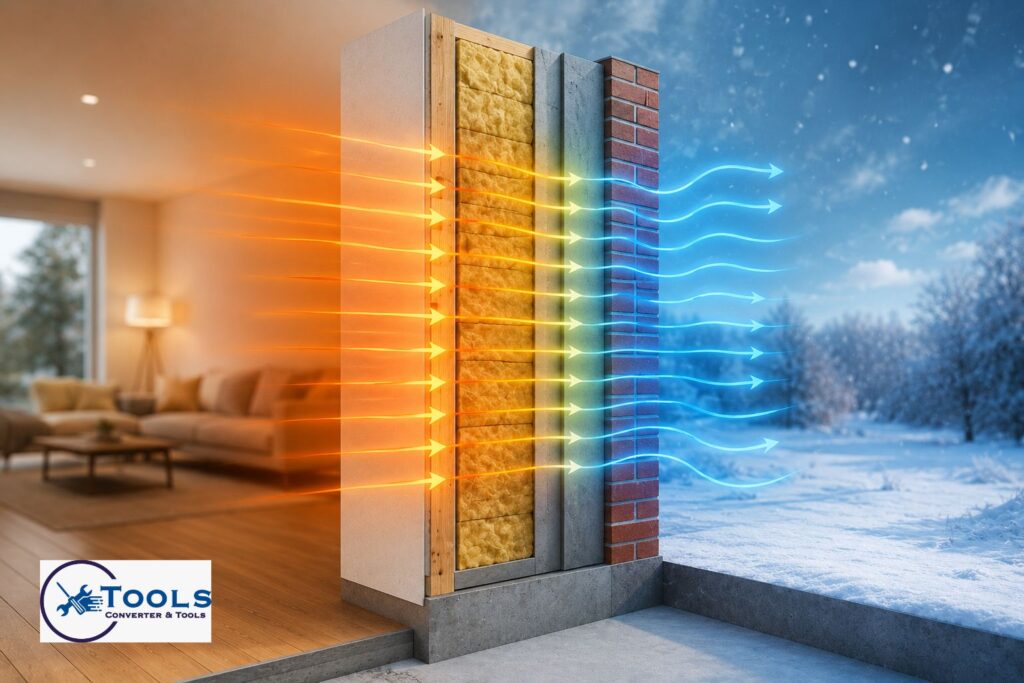
Definition of U Value
A U value measures the rate of heat transfer through a material or building assembly. It indicates how much heat is lost through one square meter of a structure when there is a temperature difference of one degree between the inside and outside.
The standard unit for U value is:
W/(m²·K)
This stands for watts per square meter per degree Kelvin.
Understanding Thermal Transmittance
Thermal transmittance refers to the movement of heat through materials. Every building component allows some heat to pass through it. The amount of heat transfer depends on the materials used and their insulating properties.
The purpose of a u value calculator is to determine this heat transfer rate accurately.
Why Lower U Values Are Better
Lower U values indicate better insulation performance. Buildings with lower U values lose less heat during winter and gain less heat during summer.
Benefits include:
- Reduced heating costs
- Lower cooling expenses
- Improved indoor comfort
- Better energy efficiency
- Reduced environmental impact
U Value vs R Value
Many people confuse U values and R values.
The R value measures thermal resistance, while the U value measures thermal transmittance.
A high R value indicates strong insulation.
A low U value indicates strong insulation.
These values are directly related and can be converted using a simple formula.
How to Use the U Value Calculator
Select the Building Element Type
Start by choosing the building element you want to evaluate.
Options typically include:
- External walls
- Roofs
- Floors
- Windows
- Custom assemblies
Different building elements use different surface resistance values, which affect the final calculation.
Add Material Layers
Next, add the layers that make up the structure.
For example, an external wall may include:
- Brick
- Insulation
- Air cavity
- Plasterboard
Each layer contributes to the overall thermal resistance.
Enter Thickness and Conductivity Values
For every layer, enter:
- Thickness in millimeters
- Thermal conductivity (λ value)
Thermal conductivity measures how easily heat passes through a material.
Materials with low conductivity values provide better insulation.
Calculate the U Value
Once all layers are entered, click the calculate button.
The calculator automatically determines:
- Thermal resistance of each layer
- Total thermal resistance
- Overall U value
- Heat loss estimates
Review the Results
The results section typically displays:
- U value
- Total R value
- Total thickness
- Heat loss rate
- Layer-by-layer breakdown
These results help users evaluate insulation performance and identify opportunities for improvement.
U Value Calculation Formula
Thermal Resistance Formula
The thermal resistance of a layer is calculated using:
R = Thickness ÷ Thermal Conductivity
Where:
- R = Thermal resistance (m²K/W)
- Thickness = Material thickness in meters
- λ = Thermal conductivity (W/mK)
Total R Value Formula
The total resistance includes all material layers plus internal and external surface resistances.
R Total = Rsi + R1 + R2 + R3 + … + Rse
Where:
- Rsi = Internal surface resistance
- Rse = External surface resistance
U Value Formula
After calculating the total resistance, the U value is determined using:
U = 1 ÷ R Total
This formula converts total thermal resistance into thermal transmittance.
Surface Resistance Factors Explained
Surface resistance accounts for heat transfer at the inner and outer surfaces of a building element.
These values vary depending on whether the assembly is a wall, roof, floor, or window.
Including these resistances ensures more accurate calculations.
Example U Value Calculations
External Wall Example
Consider a wall with:
- 102 mm brick
- 100 mm mineral wool insulation
The calculator determines the resistance of each layer and combines them with surface resistances.
The result may produce a U value around:
0.30 W/(m²·K)
This represents good insulation performance.
Roof Insulation Example
A roof assembly containing:
- 200 mm mineral wool
- Plasterboard lining
Typically achieves a much lower U value due to the thicker insulation layer.
Possible result:
0.15 W/(m²·K)
This is considered excellent thermal performance.
Floor Construction Example
A floor system with:
- Concrete slab
- Rigid insulation
- Screed
May achieve U values between:
0.18 and 0.25 W/(m²·K)
depending on insulation thickness.
Window and Glazing Example
Glazing systems often have higher U values than insulated walls.
Typical examples include:
- Single glazing: 5.0–6.0 W/(m²·K)
- Double glazing: 2.5–3.0 W/(m²·K)
- Triple glazing: 0.7–1.0 W/(m²·K)
The calculator helps compare different glazing options.
Understanding the Results
Total U Value
The U value is the primary result.
It shows the amount of heat lost through the building element.
Lower values indicate better insulation.
Total R Value
The total R value represents the combined thermal resistance of all layers.
Higher R values indicate stronger resistance to heat flow.
Heat Loss Estimation
Many calculators estimate heat loss based on a temperature difference.
This helps users understand real-world energy performance.
For example:
A wall with a lower U value will lose significantly less heat during winter.
Layer-by-Layer Breakdown
The breakdown table shows how each material contributes to the total resistance.
This information helps identify which layers provide the greatest insulation benefits.
Common Building Materials and Their Thermal Conductivity
Insulation Materials
Popular insulation materials include:
- Mineral wool
- Glass wool
- EPS insulation
- XPS insulation
- Polyurethane foam
- Phenolic foam
These materials generally have very low conductivity values.
Masonry and Concrete Materials
Common structural materials include:
- Brick
- Dense concrete
- Lightweight concrete
- Aerated concrete blocks
These materials provide structural strength but typically offer less insulation.
Timber and Wood Products
Wood-based materials include:
- Softwood timber
- Hardwood timber
- Plywood
- OSB
- MDF
These materials often provide moderate thermal performance.
Roofing and Flooring Materials
Examples include:
- Clay roof tiles
- Concrete roof tiles
- Ceramic tiles
- Laminate flooring
- Hardwood flooring
- Screed
Their contribution varies depending on thickness and conductivity.
Why U Values Matter
Improving Energy Efficiency
Buildings with lower U values require less energy to maintain comfortable temperatures.
This reduces overall energy consumption.
Reducing Heating and Cooling Costs
Better insulation means heating and cooling systems operate more efficiently.
Over time, this can result in substantial savings.
Meeting Building Regulations
Many countries have building codes that specify maximum allowable U values.
A u value calculator helps verify compliance before construction begins.
Enhancing Indoor Comfort
Well-insulated buildings experience:
- Fewer drafts
- More stable temperatures
- Improved comfort throughout the year
Tips for Achieving Better U Values
Increase Insulation Thickness
Adding insulation is one of the most effective ways to lower U values.
Thicker insulation generally improves thermal performance.
Choose Low-Conductivity Materials
Materials with lower thermal conductivity provide greater resistance to heat transfer.
Minimize Thermal Bridging
Thermal bridges allow heat to bypass insulation.
Reducing these weak points improves overall efficiency.
Upgrade Windows and Doors
Modern double and triple glazing systems can significantly reduce heat loss.
U Value Rating Guide
Excellent U Values
Below 0.15 W/(m²·K)
Excellent thermal performance and energy efficiency.
Good U Values
0.15 to 0.30 W/(m²·K)
Suitable for most modern energy-efficient buildings.
Average U Values
0.30 to 0.60 W/(m²·K)
Acceptable but may benefit from additional insulation.
Poor U Values
Above 0.60 W/(m²·K)
High heat loss and reduced energy efficiency.
Benefits of Using This Free U Value Calculator
Fast and Accurate Calculations
Results are generated instantly without manual calculations.
Easy Material Selection
Users can choose from a wide range of common building materials.
Suitable for Multiple Building Elements
The calculator works for:
- Walls
- Roofs
- Floors
- Windows
Helpful for Planning Projects
It supports insulation upgrades, renovations, and new construction projects.
Free Volume of Cylinder Calculator with Instant Results
Frequently Asked Questions
What is a good U value for a wall?
A modern insulated wall typically achieves a U value between 0.15 and 0.30 W/(m²·K).
How is U value different from R value?
The U value measures heat transfer, while the R value measures thermal resistance. They are inversely related.
Can I calculate U values for roofs and floors?
Yes. A u value calculator can be used for walls, roofs, floors, windows, and custom assemblies.
Why do surface resistances affect U values?
Surface resistances account for heat transfer at internal and external surfaces, improving calculation accuracy.
Does a lower U value mean better insulation?
Yes. Lower U values indicate less heat loss and better thermal performance.
Conclusion
A u value calculator is an essential tool for evaluating the thermal performance of walls, roofs, floors, and windows. By calculating heat transfer rates accurately, it helps users improve energy efficiency, reduce heating and cooling costs, and make informed construction decisions.
Whether you are planning a new build, upgrading insulation, or comparing building materials, understanding U values can help create a more comfortable and energy-efficient building. Using a reliable u value calculator makes the process fast, simple, and accurate.
