Your generated countries will appear here
Select your preferences and click the generate button.
Favorite Names
0No favorite names saved yet.
Recent Generations
Your recent country names will appear here.
Creating a believable country name can be surprisingly difficult. A good name needs to match the setting, sound natural, and remain easy to remember. Writers, game developers, students, and worldbuilders often spend a long time testing different words before finding one that feels right.
A country name generator makes this process faster. Instead of building every name manually, the tool combines carefully selected prefixes, root words, suffixes, language styles, and naming patterns. Within seconds, it can produce several ideas for realistic nations, fantasy kingdoms, island states, ancient empires, or futuristic civilizations.
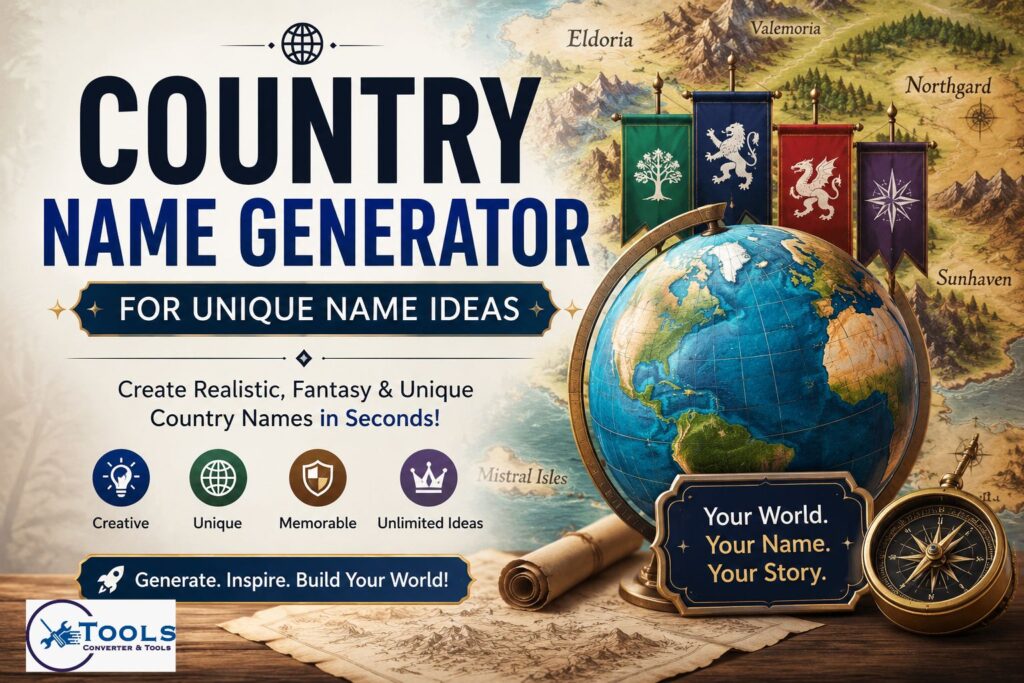
This type of generator is especially useful when you need quick inspiration. You can enter a theme, select a style, choose a preferred name length, and generate multiple results. You can then copy the best option, save it, or generate another list.
What Is a Country Name Generator?
A country name generator is an online naming tool that creates fictional country names automatically. It uses groups of letters, syllables, prefixes, endings, and style rules to form new combinations.
For example, the tool may combine a prefix such as “Nova,” a root such as “terra,” and an ending such as “ia.” The final result could be “Novaterria.”
The tool is not limited to one type of name. Depending on its available settings, it may create:
- Realistic country names
- Fantasy kingdom names
- Ancient empire names
- Island nation names
- Futuristic country names
- Peaceful republic names
- Dark or mysterious realm names
The purpose is not to copy the names of real countries. Instead, the generator creates fresh ideas that can be adapted for creative projects.
How to Use the Country Name Generator
Using the tool is simple. Most users can generate useful names in only a few steps.
Enter a Theme
Start by entering an optional keyword or theme. This may be a word connected to the country’s geography, culture, history, atmosphere, or political identity.
Useful theme examples include:
- Fire
- Moon
- Ocean
- Forest
- Gold
- Peace
- Storm
- Dragon
- Crystal
- Mountain
A theme helps guide the naming process. For example, entering “moon” may produce names with a soft, mysterious, or celestial sound. Entering “fire” may create stronger and more energetic combinations.
You can also leave the field blank. In that case, the country name generator will create names from its standard naming patterns.
Choose a Country Style
Next, choose the type of country name you need. Different styles use different naming structures.
A realistic setting may use familiar endings such as “-ia,” “-land,” “-stan,” or “-onia.” A fantasy setting may use imaginative sounds such as “Vael,” “Eld,” “Thorn,” or “Aether.”
Common style options include:
- Realistic nation
- Fantasy kingdom
- Ancient empire
- Modern republic
- Futuristic nation
- Island country
- Royal monarchy
- Dark kingdom
Selecting the right style improves the quality of the results because it makes the generated names more suitable for your project.
Select Language Inspiration
Language inspiration affects how the name sounds. It does not necessarily create a word from a real language. Instead, it uses sound patterns that may feel European, Nordic, Latin, Celtic, Arabic, Asian, African, Greek, or Slavic.
For example, Nordic-inspired names may contain stronger consonants and endings such as “-heim,” “-vik,” or “-gard.” Latin-inspired names may use endings such as “-ium,” “-ia,” or “-ora.”
This setting is useful when your fictional world has a specific cultural or historical atmosphere.
Choose the Name Length
You can often select short, medium, long, or mixed-length names.
Short names are easy to remember and work well for maps, strategy games, and modern fictional nations. Medium names usually sound balanced and natural. Long names can feel formal, royal, ancient, or ceremonial.
A short result might be “Valora,” while a longer result could be “The Grand Federation of Valoria.”
Select the Number of Results
Choose how many names you want the tool to generate. A smaller list is useful when you want quick inspiration. A larger list gives you more options to compare.
Generating eight to twelve names is usually a practical starting point. It provides variety without making the selection process overwhelming.
Generate and Review the Names
Click the generate button to create the results. The main suggestion should appear as an H2 result, while additional ideas may appear as H4 headings or separate result cards.
Review the names based on pronunciation, originality, theme, and suitability. You can copy your favorite name, save it, or regenerate the list.
How the Generator Works
A country name generator normally uses a rule-based naming system. It stores different word parts and combines them according to the selected style.
The process can include several stages.
Prefix Selection
A prefix is the first part of a name. Examples may include:
- Al
- Bel
- Nova
- Val
- Eld
- Nor
- Sol
- Zeph
Prefixes help establish the opening sound of the country name. Softer prefixes may create peaceful or elegant names, while harder sounds can create powerful or warlike names.
Root Word Creation
The root is the central part of the name. It gives the word its main identity.
A root can be created from vowels, consonants, or theme-related words. For example, a tool may use “terr” for land, “mar” for sea, or “sol” for sun.
Some generators also blend the user’s keyword with a randomly selected root.
Suffix Generation
A suffix appears at the end of the name. It often makes the result sound like a place, nation, kingdom, or region.
Common fictional country endings include:
- -ia
- -land
- -stan
- -ora
- -eria
- -onia
- -heim
- -gard
- -polis
- -ara
The suffix has a strong effect on the final style. “Valoria” feels different from “Valgard,” even though both begin with the same root.
Style Rules
The selected style controls which prefixes, roots, and endings can be combined.
A modern country name generator may create results such as “Republic of Arden” or “New Valora.” A fantasy style may create “Eldoria” or “Vaelthorn.” A futuristic setting may produce “Neo Solaris” or “Zenith Prime.”
These rules prevent every result from sounding the same.
Random Variation
Random variation helps create new combinations each time the tool runs. The generator may change the prefix, root, ending, name length, or official title.
This is why clicking the generate button again usually produces a different list.
Country Name Generation Formula
Unlike a mathematical converter, a naming generator does not use a fixed numerical formula. However, its logic can still be explained with a simple structure.
Basic Formula
Country Name = Prefix + Root Word + Suffix + Style Rules + Random Variation
Each part contributes something different.
The prefix creates the opening sound. The root gives the name its identity. The suffix makes it sound like a country or region. Style rules control the overall tone, while random variation keeps the results fresh.
Formula Example
Consider the following parts:
- Prefix: Nova
- Root: terr
- Suffix: ia
- Style: Futuristic
- Final result: Novaterria
Another example could be:
- Prefix: Val
- Root: or
- Suffix: ia
- Style: Realistic
- Final result: Valoria
A royal naming formula may include an official title:
- Title: Kingdom of
- Root name: Eldoria
- Final result: Kingdom of Eldoria
These combinations show how a country name generator turns small word elements into complete fictional names.
Country Name Examples
Different settings produce different types of results. The following examples show how styles can affect the final names.
Fantasy Country Names
Fantasy names often use dramatic or magical sounds.
Examples include:
- Eldoria
- Vaelthorn
- Aetherwyn
- Drakoria
- Sylvaran
These names may suit novels, role-playing games, magical maps, and fictional kingdoms.
Realistic Country Names
Realistic names are designed to sound similar to names that could exist in the real world.
Examples include:
- Valeria
- Norvania
- Beloria
- Estavia
- Corland
They are useful for political fiction, alternate-history stories, simulations, and strategy games.
Ancient Empire Names
Ancient names often use formal endings and classical influences.
Examples include:
- Aurelium
- Arkopolis
- Helionia
- Cartheria
- Imperana
These names work well for historical fantasy, old civilizations, lost empires, and archaeological settings.
Island Nation Names
Island names often include references to oceans, ports, coral, or coastal geography.
Examples include:
- Azure Isles
- Port Marisia
- Coralora
- Oceara
- Valen Atoll
They may be suitable for adventure stories, tropical worlds, pirate games, or travel-themed fiction.
Futuristic Country Names
Futuristic names often combine modern technology terms with geographic or political words.
Examples include:
- Neo Valoria
- Solaris Prime
- Zenith Terra
- Quantum Aria
- Cyber Norland
These names can be used in science-fiction novels, space games, dystopian worlds, or advanced civilizations.
Popular Country Naming Styles
Understanding different naming styles can help you select a stronger result.
Realistic Names
Realistic names usually have simple spellings and familiar geographic endings. They should be easy to pronounce and should not feel overly dramatic.
These names are a good choice when your fictional country exists in a world similar to the modern Earth.
Fantasy Kingdoms
Fantasy names may be more decorative and imaginative. They often contain unusual letter combinations, magical roots, or royal titles.
A fantasy country name generator is useful when your setting includes magic, mythical creatures, ancient wars, or legendary rulers.
Historical Empires
Historical-style names often sound formal and powerful. They may include titles such as Empire, Dominion, Kingdom, or Grand Republic.
These names should reflect age, authority, and cultural depth.
Science-Fiction Nations
Science-fiction names may sound technological, planetary, or highly organized. They often use terms such as Neo, Nova, Prime, Core, Sector, or Federation.
These names are useful for future societies, space colonies, and interplanetary alliances.
Features of a Good Country Name Generator
A useful generator should offer more than a single random result.
Multiple Naming Styles
Users should be able to choose between realistic, fantasy, modern, ancient, island, royal, dark, and futuristic names.
Keyword-Based Results
A keyword field allows users to connect the generated names with a theme or story idea.
Custom Prefixes and Suffixes
Advanced tools may allow users to add their own prefix or suffix. This gives more control over the final output.
Multiple Results
A multi-result system makes it easier to compare options. The strongest suggestion can appear as the main result, while related ideas appear below it.
Copy and Save Options
One-click copy buttons help users move names into documents, games, notes, or planning tools. A favorites section is also useful for saving the best results.
Country Details
A professional country name generator may also create supporting details such as:
- Capital city
- Demonym
- Government type
- National motto
- Flag concept
- Pronunciation guide
These details can turn a simple name into a more complete worldbuilding idea.
Best Uses for Generated Names
Generated names can support many types of creative work.
Fiction Writing
Novelists can use the tool when building fictional nations, kingdoms, regions, and political systems.
Video Games
Game developers can create names for playable nations, enemy territories, factions, and map locations.
Fantasy Maps
A country name generator is useful when labeling maps for novels, games, classroom activities, or personal projects.
Tabletop Games
Dungeon masters and role-playing players can quickly create nations for campaigns without spending hours brainstorming.
School Projects
Students can use fictional country names for geography exercises, government projects, presentations, and creative assignments.
Tips for Choosing a Country Name
The generator provides ideas, but the final choice still matters.
Match the Setting
A futuristic name may not suit a medieval story. Choose a result that matches the time period, technology level, and culture of your world.
Keep It Pronounceable
A reader should be able to guess how the name is spoken. Names with too many difficult consonants may be hard to remember.
Check the Length
Short names work well on maps and menus. Longer names may suit formal empires, political unions, or historical states.
Avoid Close Copies
Make sure the result is not too similar to the name of a real country, famous fictional place, or major brand.
Consider the People
Think about how the country name will connect to its citizens. For example, a country called Valoria might have citizens known as Valorians.
Common Mistakes to Avoid
One common mistake is choosing a name only because it sounds impressive. The name should also fit the country’s history, language, climate, and culture.
Another mistake is using too many prefixes and suffixes at once. A name such as “Neo Grand Valorian Empireland” may feel crowded and unnatural.
Difficult spelling is another problem. Readers may lose interest if they cannot remember or pronounce the country name.
It is also helpful to test the name in a sentence. For example: “The army of Valoria crossed the northern border.” If the sentence sounds natural, the name is probably usable.
Best Locro de Zapallo Near Me Restaurant Locator
Frequently Asked Questions
What is a country name generator?
A country name generator is an online tool that automatically creates fictional country names. It combines prefixes, roots, suffixes, themes, and naming styles to produce unique suggestions.
Is the country name generator free to use?
Yes. A browser-based generator can normally be used without payment or registration. Users can generate multiple name lists and copy the results they like.
Can I generate fantasy country names?
Yes. Select the fantasy option to create names that suit magical kingdoms, role-playing games, novels, and fictional maps.
Can I use generated names in a book or game?
Generated names are intended as creative suggestions. You can adapt them for stories, games, maps, or personal projects. It is still sensible to check that your chosen name is not already strongly associated with an existing brand or major fictional property.
Can the tool create realistic country names?
Yes. Choose the realistic style and select a suitable language inspiration. The tool will use more familiar sounds and geographic endings to create believable results.
Conclusion
A country name generator is a practical tool for anyone who needs original fictional names quickly. It removes the pressure of starting from a blank page and provides multiple ideas based on your selected theme, style, region, and name length.
The tool can create realistic nations, fantasy kingdoms, island states, ancient empires, and futuristic civilizations. Advanced features such as custom prefixes, saved favorites, pronunciation guides, capitals, mottos, and government types make the results even more useful.
Generate several options, compare how they sound, and choose the name that best matches your setting. A strong country name should be clear, memorable, pronounceable, and connected to the world you are creating.
