
Quadratic Equation Solver Pro
Solve quadratic equations using standard, vertex, or factored forms. Get exact roots, conics properties (Focus & Directrix), calculus derivatives, and interactive graph hover guides.
x₁ = 3, x₂ = 2
1.00
Two Distinct Real Roots
(2.5, -0.25)
(0, 6.0)
x = 2.5
Opens Upward
y = (x – 2.5)² – 0.25
R: [-0.25, ∞)
(2.5, 0.0)
y = -0.5
0.25
1.0
y’ = 2x – 5
Calculates the tangent slope at any point x.
x³/3 – 2.5x² + 6x + C
Calculates the accumulated area under the curve.
| Point | x | y = ax² + bx + c | Ordered Pair (x, y) | Description |
|---|
What is a Quadratic Equation?
A quadratic equation is a second-degree polynomial equation in a single variable. The standard format is written as:
ax² + bx + c = 0
Where a, b, and c are numbers (coefficients) and a ≠ 0. The term “quadratic” comes from “quad”, meaning square, because the variable x is squared.
What is the Quadratic Formula?
The quadratic formula is a mathematical formula used to find the solutions (roots) of any quadratic equation. It is derived by completing the square on the standard form of the equation:
The symbol “±” means that there are two potential answers: one calculating with addition, and the other with subtraction.
What is the Discriminant (D)?
The portion of the quadratic formula underneath the radical sign is called the discriminant:
D = b² – 4ac
The value of the discriminant determines the number and type of roots (solutions) you will get:
- D > 0: Two distinct real roots (the parabola crosses the x-axis at two points).
- D = 0: One repeated real root (the vertex of the parabola touches the x-axis).
- D < 0: Two conjugate complex/imaginary roots (the parabola does not cross or touch the x-axis).
How to find the Vertex of a Parabola?
The vertex represents the maximum or minimum peak of the parabola. The x-coordinate of the vertex (h) is given by:
h = -b / 2a
To find the y-coordinate (k) of the vertex, substitute h back into the original quadratic equation:
k = a(h)² + b(h) + c
This vertex form allows you to easily read the symmetry and the range bounds of the quadratic curve.
A quadratic formula calculator is a simple online tool that helps you solve quadratic equations quickly and accurately. Instead of working through every step by hand, you can enter the values of a, b, and c, and the calculator gives you the roots, discriminant, solution type, and sometimes even a graph of the equation.
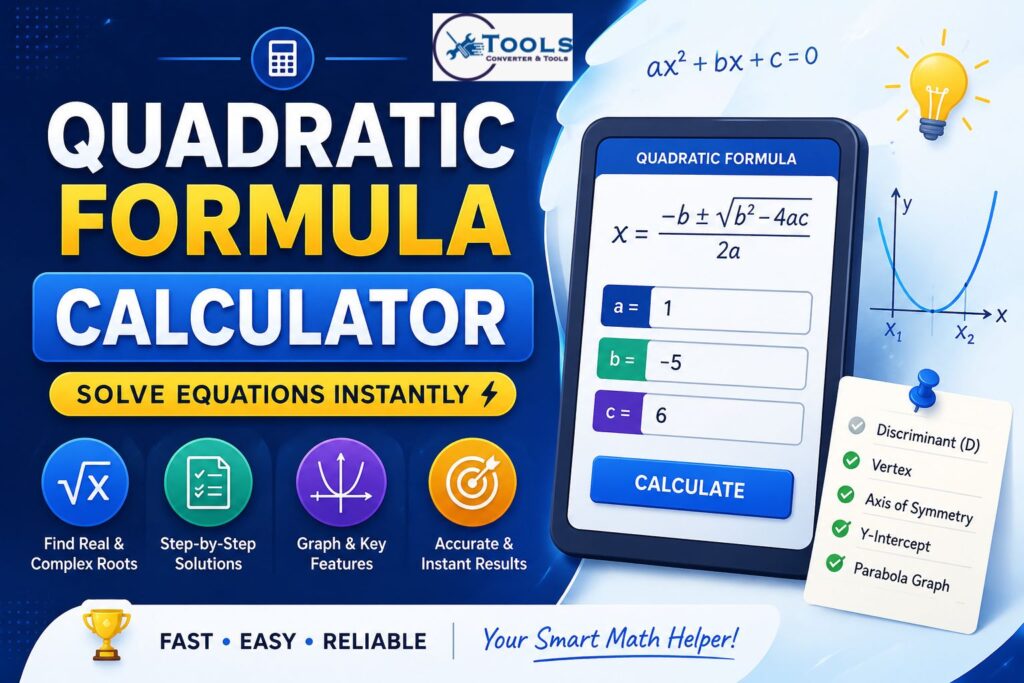
Quadratic equations are common in algebra, physics, engineering, finance, and many real-life problem-solving situations. They usually appear in the form:
ax² + bx + c = 0
For many students and professionals, solving these equations manually can take time, especially when the numbers are large, negative, fractional, or produce complex roots. This is where a quadratic formula calculator becomes useful. It saves time, reduces mistakes, and gives clear results in seconds.
What Is a Quadratic Equation?
A quadratic equation is a second-degree equation because the highest power of the variable is 2. The general form is:
ax² + bx + c = 0
Here, a, b, and c are coefficients. The value of a cannot be zero because if a = 0, the equation becomes linear, not quadratic.
For example:
x² – 5x + 6 = 0
In this equation:
a = 1
b = -5
c = 6
The goal is to find the value or values of x that make the equation true.
What Is a Quadratic Formula Calculator?
A quadratic formula calculator is an online equation-solving tool that uses the quadratic formula to find the solutions of a quadratic equation. These solutions are also called roots or zeros.
The calculator usually asks you to enter three values:
a – the coefficient of x²
b – the coefficient of x
c – the constant value
After entering these values, the calculator applies the quadratic formula and gives the answer. Many advanced calculators also show the step-by-step solution, discriminant, vertex, axis of symmetry, and graph.
How to Use the Calculator
Using a quadratic formula calculator is easy. You do not need advanced math knowledge to get started.
Step 1: Enter the Value of a
First, enter the coefficient of x². This is the value called a.
For example, in:
2x² + 7x + 3 = 0
The value of a is 2.
Step 2: Enter the Value of b
Next, enter the coefficient of x. This is the value called b.
In:
2x² + 7x + 3 = 0
The value of b is 7.
Step 3: Enter the Value of c
Now enter the constant number. This is the value called c.
In:
2x² + 7x + 3 = 0
The value of c is 3.
Step 4: Calculate the Result
After entering all three values, click the calculate button. The quadratic formula calculator will instantly solve the equation and display the roots.
Some calculators also show exact answers, decimal answers, and graph details.
Quadratic Formula
The main formula used by the calculator is:
x = (-b ± √(b² – 4ac)) / 2a
This formula works for almost every quadratic equation written in standard form.
The symbol ± means plus or minus. This is why a quadratic equation can have two solutions.
One solution is calculated using plus:
x = (-b + √(b² – 4ac)) / 2a
The other solution is calculated using minus:
x = (-b – √(b² – 4ac)) / 2a
What Is the Discriminant?
The discriminant is the part inside the square root:
D = b² – 4ac
The discriminant tells you what type of roots the equation has.
If D > 0, the equation has two different real roots.
If D = 0, the equation has one repeated real root.
If D < 0, the equation has two complex roots.
This makes the discriminant very useful because it explains the nature of the answer before the full solution is even calculated.
How the Calculator Works
A quadratic formula calculator follows a clear process behind the scenes.
First, it reads the values of a, b, and c entered by the user. Then it checks whether the value of a is valid. If a = 0, the equation is not quadratic.
Next, the calculator finds the discriminant using:
D = b² – 4ac
After that, it places the values into the quadratic formula:
x = (-b ± √D) / 2a
Finally, it displays the solutions. If the discriminant is positive, the calculator shows two real roots. If it is zero, it shows one repeated root. If it is negative, it shows complex roots.
Example 1: Two Real Roots
Solve:
x² – 5x + 6 = 0
Here:
a = 1
b = -5
c = 6
Now find the discriminant:
D = b² – 4ac
D = (-5)² – 4(1)(6)
D = 25 – 24
D = 1
Since the discriminant is greater than zero, the equation has two real roots.
Now apply the formula:
x = (5 ± √1) / 2
So:
x = (5 + 1) / 2 = 3
x = (5 – 1) / 2 = 2
The solutions are:
x = 3 and x = 2
Example 2: One Repeated Root
Solve:
x² – 6x + 9 = 0
Here:
a = 1
b = -6
c = 9
Find the discriminant:
D = (-6)² – 4(1)(9)
D = 36 – 36
D = 0
Since the discriminant is zero, the equation has one repeated root.
Apply the formula:
x = 6 / 2
So:
x = 3
The solution is:
x = 3
This means the graph touches the x-axis at one point.
Example 3: Complex Roots
Solve:
x² + 2x + 5 = 0
Here:
a = 1
b = 2
c = 5
Find the discriminant:
D = 2² – 4(1)(5)
D = 4 – 20
D = -16
Since the discriminant is negative, the equation has complex roots.
Apply the formula:
x = (-2 ± √-16) / 2
Since √-16 = 4i, the roots are:
x = (-2 ± 4i) / 2
So:
x = -1 ± 2i
The solutions are:
x = -1 + 2i
x = -1 – 2i
Example 4: Fractional Roots
Solve:
2x² + 5x – 3 = 0
Here:
a = 2
b = 5
c = -3
Find the discriminant:
D = 5² – 4(2)(-3)
D = 25 + 24
D = 49
Apply the formula:
x = (-5 ± √49) / 4
So:
x = (-5 + 7) / 4 = 1/2
x = (-5 – 7) / 4 = -3
The solutions are:
x = 1/2 and x = -3
Understanding the Results
A good quadratic formula calculator does more than show the final roots. It helps you understand the equation better.
The roots show where the graph crosses the x-axis. The discriminant explains whether the roots are real or complex. The vertex shows the highest or lowest point of the parabola. The axis of symmetry shows the vertical line that divides the parabola into two equal parts.
For example, if the calculator shows:
Vertex: (2.5, -0.25)
It means the turning point of the parabola is at x = 2.5 and y = -0.25.
If the calculator shows:
Axis of symmetry: x = 2.5
It means the graph is balanced around this vertical line.
Why Use an Online Calculator?
An online quadratic formula calculator is helpful because it makes solving equations faster and easier. It is especially useful when checking homework, preparing for exams, solving physics problems, or working with technical calculations.
Manual solving is important for learning, but online tools help you verify your answers. They are also useful when you need quick results without spending too much time on repeated calculations.
Common Uses
Quadratic equations appear in many areas.
In school algebra, they are used to practice solving equations and graphing parabolas. In physics, they can describe motion, height, distance, and projectile paths. In engineering, they help with design calculations and curve analysis. In business and finance, quadratic models can appear in profit, cost, and revenue problems.
Because of these uses, a quadratic formula calculator is not only for students. It can also help teachers, engineers, researchers, and anyone working with mathematical models.
Tips for Accurate Answers
Always enter the equation in standard form before using the calculator:
ax² + bx + c = 0
Make sure you place each number in the correct field. The most common mistake is entering the wrong sign. For example, -5 and 5 will give very different results.
Also, check that the value of a is not zero. If a = 0, the equation is not quadratic and should be solved as a linear equation.
Common Mistakes to Avoid
One common mistake is forgetting negative signs. If the equation is:
x² – 4x + 3 = 0
Then b = -4, not 4.
Another mistake is using the equation before moving all terms to one side. The calculator works best when the equation is written equal to zero.
For example:
x² + 3x = 10
should be rewritten as:
x² + 3x – 10 = 0
Now you can enter:
a = 1
b = 3
c = -10
Benefits of This Tool
A quadratic formula calculator gives fast and reliable results. It reduces calculation errors and helps users understand the steps behind the answer.
It is useful for quick solving, answer checking, graph understanding, and learning the connection between formulas and results. Since it works online, users can access it from a computer, tablet, or mobile phone.
For a converter tools website, this calculator adds strong value because users often need fast mathematical conversions and equation-solving tools in one place.
Standard Deviation Calculator for Fast and Accurate Results
FAQs
What is a quadratic formula calculator?
A quadratic formula calculator is an online tool that solves quadratic equations using the formula x = (-b ± √(b² – 4ac)) / 2a. It helps find roots quickly and accurately.
Can it solve complex roots?
Yes. If the discriminant is negative, the calculator can show complex roots using the imaginary number i.
What happens if a is zero?
If a = 0, the equation is not quadratic. It becomes a linear equation, so the quadratic formula does not apply.
Does the calculator show steps?
Many quadratic formula calculators show step-by-step solutions, including the discriminant, formula substitution, and final roots.
Is this calculator useful for students?
Yes. It is very useful for students because it helps them check answers, understand solving steps, and learn how the quadratic formula works.
Conclusion
A quadratic formula calculator is a practical tool for solving quadratic equations quickly. It helps users find real roots, repeated roots, or complex roots without confusion.
By entering the values of a, b, and c, users can get instant answers along with useful details like the discriminant, vertex, graph behavior, and step-by-step working.
Whether you are studying algebra, checking homework, solving a physics problem, or working with mathematical models, this calculator provides a fast and simple way to solve equations with confidence.
