
Keyword Density Checker
Check multiple keywords, density level, keyword placement, and export SEO reports instantly.
Keyword density report will appear here
Total Words
0
Keywords Checked
0
Reading Time
0 min
Status
Enter content and keywords to begin.
Introduction
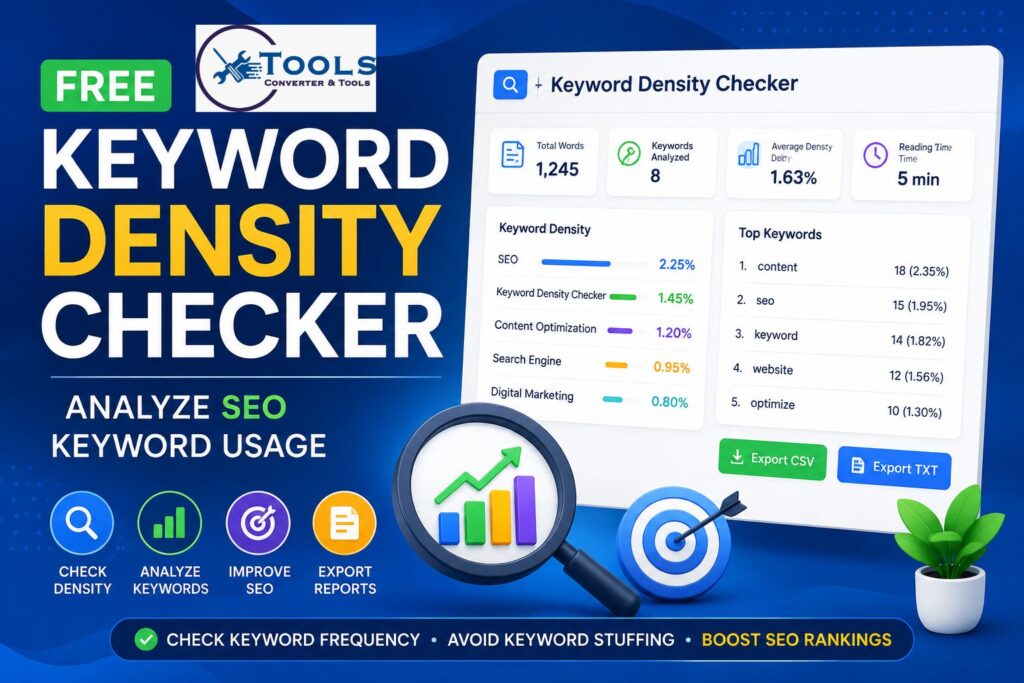
A Keyword Density Checker is a useful SEO tool that helps writers, marketers, bloggers, and website owners analyze how often keywords appear within content. Understanding keyword usage is important because it helps ensure that content remains relevant, readable, and properly optimized for search engines.
In the past, many website owners focused heavily on repeating keywords to improve rankings. Today, search engines are much smarter. They reward natural, high-quality content that provides value to readers. A Keyword Density Checker helps maintain the right balance between optimization and readability.
Whether you are writing a blog post, product description, landing page, or website article, this tool can help you monitor keyword usage and avoid common SEO mistakes.
What Is a Keyword Density Checker?
A Keyword Density Checker is an online analysis tool that measures how frequently a keyword or phrase appears in a piece of content compared to the total number of words.
The tool calculates:
- Keyword occurrences
- Keyword density percentage
- Multiple keyword analysis
- Keyword placement
- Keyword stuffing warnings
- Top keyword reports
- Content statistics
These insights allow users to improve content quality while maintaining a natural writing style.
Why Keyword Density Matters
Keyword density helps search engines understand the topic of a page.
When keywords appear naturally throughout content, search engines can better identify relevance. However, excessive keyword repetition may reduce readability and create a poor user experience.
A balanced keyword strategy can help:
- Improve content relevance
- Support SEO efforts
- Increase readability
- Prevent keyword stuffing
- Enhance user engagement
A Keyword Density Checker helps identify whether keywords are being used too little, too often, or in a balanced way.
How to Use the Keyword Density Checker
Step 1: Enter Your Content
Paste your article, blog post, webpage content, or product description into the content area.
The tool supports both short and long-form content.
Step 2: Add Keywords
Enter one or multiple keywords separated by commas or new lines.
Example:
seo
keyword density checker
content optimization
Step 3: Select Analysis Settings
Depending on the tool, users may choose options such as:
- Case-sensitive matching
- Stop-word filtering
- Multi-keyword analysis
- Top keyword limits
Step 4: Run the Analysis
Click the analysis button to process the content.
The Keyword Density Checker will instantly generate a detailed report.
Step 5: Review Results
Analyze:
- Keyword frequency
- Density percentages
- Keyword placement
- SEO recommendations
- Top keyword reports
The results can usually be copied or exported for later use.
Main Features of the Keyword Density Checker
Multi-Keyword Analysis
Instead of checking a single keyword, modern tools can analyze multiple keywords simultaneously.
This allows users to optimize content for primary and secondary search terms.
Exact Keyword Match Detection
The tool can identify exact keyword matches rather than partial matches.
This improves reporting accuracy.
Keyword Frequency Count
Frequency count shows how many times a keyword appears within the content.
This provides a clear overview of keyword usage.
Keyword Density Percentage
The density percentage reveals how often a keyword appears relative to the total number of words.
This metric helps determine whether optimization levels are appropriate.
Top Keywords Analysis
The tool can display the most frequently used words and phrases.
This helps identify content themes and repetitive wording.
Keyword Placement Check
Many advanced Keyword Density Checker tools analyze whether keywords appear in important locations such as:
- Page titles
- Headings
- First paragraph
- Last paragraph
Proper placement often improves content relevance.
Keyword Stuffing Detection
The tool can identify overused keywords and warn users when density becomes excessive.
Reading Time Estimation
Reading time estimates help content creators understand how long users may spend reading the content.
Export Options
Reports can often be exported as:
- CSV files
- TXT files
- Printable reports
This makes SEO analysis easier to share and review.
SEO Content Analysis Features
Keyword in Title Check
Search engines and users both pay attention to page titles.
A Keyword Density Checker can verify whether important keywords appear in the title.
Keyword in Headings Check
Headings help organize content and communicate relevance.
Including keywords naturally in headings can strengthen topical signals.
Keyword in First Paragraph Check
The opening paragraph introduces the main topic.
Strategic keyword placement here can improve clarity.
Keyword in Last Paragraph Check
Including keywords near the conclusion can reinforce content relevance.
Content Relevance Review
Keyword reports help ensure that content remains focused on the intended topic.
Top Performing Keywords Overview
This feature identifies which keywords dominate the content and which may need adjustment.
Keyword Density Formula
Basic Keyword Density Formula
Keyword density is calculated using a simple formula:
Keyword Occurrences ÷ Total Words × 100
This produces a percentage that represents keyword frequency.
Example Calculation
Imagine an article contains:
- Total words: 1000
- Keyword appearances: 20
Calculation:
20 ÷ 1000 × 100 = 2%
The keyword density is 2%.
Multi-Word Keyword Formula
When analyzing phrases containing multiple words, the formula becomes:
Phrase Occurrences × Phrase Word Count ÷ Total Words × 100
This provides a more accurate measurement for long-tail keywords.
Understanding Density Levels
Low Keyword Density
A very low density may indicate that the target keyword appears too infrequently.
As a result, search engines may struggle to understand the page topic.
Good Keyword Density
A moderate density usually indicates balanced optimization.
The content remains readable while maintaining topic relevance.
High Keyword Density
A high density suggests heavy keyword usage.
Writers should review the content to ensure it still reads naturally.
Too High Keyword Density
Excessive density may lead to keyword stuffing.
This can negatively affect user experience and overall content quality.
Recommended SEO Density Range
There is no universal perfect percentage.
However, many SEO professionals aim for natural keyword usage while keeping density within a reasonable range.
The primary goal should always be creating valuable content for readers.
Practical Keyword Density Examples
Example 1: Single Keyword Analysis
Keyword:
SEO
Content Statistics:
- Total words: 500
- Keyword occurrences: 10
Calculation:
10 ÷ 500 × 100 = 2%
Density Result:
2%
This generally indicates balanced keyword usage.
Example 2: Multi-Keyword Analysis
Keywords:
SEO
Content Marketing
Blogging
Results may include:
| Keyword | Count | Density |
|---|---|---|
| SEO | 15 | 2.5% |
| Content Marketing | 8 | 1.6% |
| Blogging | 6 | 1.2% |
This allows users to compare multiple keywords at once.
Example 3: Keyword Placement Analysis
The tool may show:
- Keyword in title: Yes
- Keyword in headings: Yes
- Keyword in first paragraph: Yes
- Keyword in conclusion: No
This information helps improve optimization strategies.
Top Keywords Report
Most Frequently Used Words
A Keyword Density Checker identifies commonly used words within the content.
Top 10 Keywords
Displays the ten most frequently used terms.
Top 20 Keywords
Provides a broader view of keyword usage patterns.
Top 50 Keywords
Useful for analyzing long-form content.
Stop Word Filtering
Common words such as:
- The
- And
- Is
- In
can be excluded from reports to improve accuracy.
Keyword Stuffing and SEO
What Is Keyword Stuffing?
Keyword stuffing occurs when keywords are repeated excessively in an attempt to manipulate rankings.
Why Keyword Stuffing Is Harmful
Overuse of keywords can:
- Reduce readability
- Create poor user experiences
- Make content appear unnatural
How the Tool Detects Overuse
A Keyword Density Checker compares keyword frequency against total word count and identifies unusually high percentages.
Tips for Natural Keyword Usage
- Write for readers first
- Use related terms naturally
- Avoid forcing keywords into sentences
- Focus on content quality
Benefits of Using a Keyword Density Checker
Improves SEO Optimization
Keyword analysis helps maintain relevance without over-optimization.
Enhances Content Quality
Balanced keyword usage improves readability.
Saves Time
Automated analysis replaces manual calculations.
Supports Content Marketing
Content teams can monitor optimization across multiple pages.
Improves Search Visibility
Better-optimized content may perform more effectively in search results.
Helps Identify Opportunities
Keyword reports can reveal underused terms that deserve more attention.
Who Should Use This Tool?
Bloggers
To optimize articles and maintain readability.
Content Writers
To improve keyword balance and content quality.
SEO Specialists
To monitor optimization levels.
Digital Marketers
To improve campaign content.
Website Owners
To review webpage relevance.
Students and Researchers
To analyze keyword patterns within written work.
Tips for Better Keyword Optimization
Focus on Natural Writing
Content should always be written for people first.
Use Related Keywords
Synonyms and related phrases help diversify content.
Avoid Excessive Repetition
Overusing keywords can reduce readability.
Optimize Headings and Titles
Strategic keyword placement strengthens content structure.
Review Before Publishing
Analyze content before publishing to ensure balance.
Free Character Counter Tool for Text Analysis
Frequently Asked Questions
What is a Keyword Density Checker?
A Keyword Density Checker is a tool that measures how often keywords appear within content and calculates keyword density percentages.
Is this Keyword Density Checker free to use?
Yes, most online Keyword Density Checker tools are free and available without registration.
What is the ideal keyword density?
There is no fixed percentage. Natural keyword usage and content quality are more important than targeting a specific number.
Can I check multiple keywords at once?
Yes. Most advanced tools support multi-keyword analysis.
Does the tool save my content?
Many tools process content locally and do not permanently store user data.
Conclusion
A Keyword Density Checker is an essential tool for anyone involved in content creation, blogging, SEO, or digital marketing. It helps users analyze keyword frequency, monitor density levels, identify keyword placement opportunities, and avoid keyword stuffing. By providing clear and accurate insights, the tool supports better content optimization while maintaining readability and user value. Whether you are creating a short webpage or a long-form article, a Keyword Density Checker can help ensure your content remains balanced, relevant, and effective.
