
Celsius to Fahrenheit Converter
Fast, accurate temperature conversion with formulas and related values.
Converting temperature values between different measurement systems can sometimes feel confusing, especially when you need an accurate answer quickly. A Celsius to Fahrenheit calculator makes the process simple by converting any Celsius temperature into Fahrenheit within seconds.
This online converter is useful for weather forecasts, cooking instructions, medical readings, school assignments, scientific work, and international travel. Instead of remembering a formula or calculating the result manually, you can enter a value and receive an instant conversion.
The calculator also helps reduce common mathematical mistakes. It applies the correct Celsius to Fahrenheit formula automatically and displays the result using your preferred number of decimal places.
Whether you are checking tomorrow’s weather, following an overseas recipe, or comparing temperature readings, this tool provides a fast and convenient solution.
Use the Celsius to Fahrenheit Calculator
The Celsius to Fahrenheit calculator is designed to be straightforward. You do not need technical knowledge or previous experience with temperature formulas.
Simply enter the temperature, select the correct units, and view the result.
Enter the Temperature Value
Start by typing the Celsius value you want to convert into the temperature input field.
You may enter a whole number, such as:
- 20
- 25
- 37
- 100
You can also enter a decimal value, such as:
- 18.5
- 24.7
- 36.6
- 42.25
Negative temperatures are supported as long as the value is not below absolute zero. This is useful when converting winter weather temperatures such as -5°C or -20°C.
Select the Input Unit
Choose Celsius as the starting unit. This tells the calculator that the number you entered is measured in degrees Celsius.
Some temperature tools also allow you to select Fahrenheit, Kelvin, or Rankine as the input unit. This makes the converter more flexible when you need to perform different types of temperature calculations.
Select Fahrenheit as the Output
Choose Fahrenheit as the output unit. The calculator will then convert the Celsius value into its Fahrenheit equivalent.
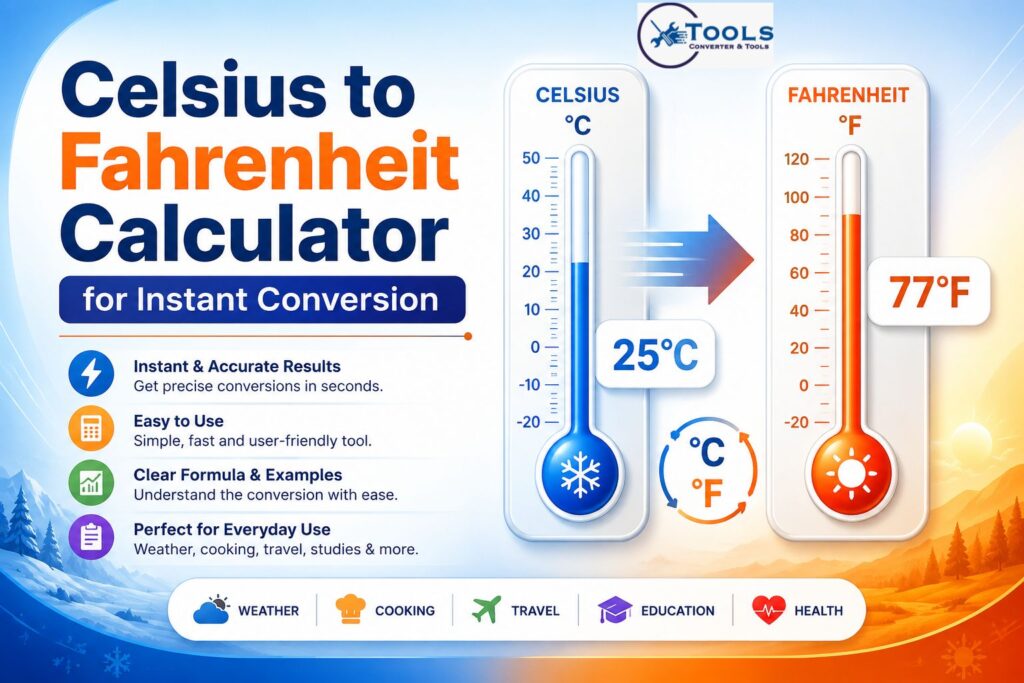
For example, entering 25°C and selecting Fahrenheit will produce a result of 77°F.
Choose Decimal Precision
You may be able to select how many decimal places should appear in the final answer.
For everyday weather readings, zero or one decimal place is usually enough. Scientific, educational, or medical calculations may require two or more decimal places.
For example:
- 22°C = 71.6°F
- 22°C = 71.60°F
- 22°C = 71.600°F
The actual value remains the same. Only the displayed level of precision changes.
View the Instant Result
After entering the value, the converted temperature appears immediately. Some converters update automatically as you type, while others require you to press a Convert button.
The main result usually shows both the converted number and its unit symbol. This makes it easy to distinguish between Celsius and Fahrenheit.
Copy or Swap the Conversion
A copy button allows you to save the result to your clipboard. You can then paste it into a document, message, worksheet, or report.
The Swap Units option reverses the direction of the conversion. Instead of converting Celsius to Fahrenheit, you can quickly switch to Fahrenheit to Celsius without reloading the page.
Celsius to Fahrenheit Conversion Formula
The relationship between Celsius and Fahrenheit is based on a fixed mathematical formula.
To convert Celsius to Fahrenheit, use:
°F = (°C × 9/5) + 32
You can also write the same formula as:
°F = (°C × 1.8) + 32
Both versions produce the same result.
How the Formula Works
The Celsius and Fahrenheit scales use different starting points and different interval sizes.
One degree Celsius is equal to 1.8 degrees Fahrenheit. This is why the Celsius value is multiplied by 1.8, or 9/5.
After multiplying, you add 32 because the freezing point of water is 0°C on the Celsius scale but 32°F on the Fahrenheit scale.
For example, convert 20°C to Fahrenheit:
20 × 1.8 = 36
Then add 32:
36 + 32 = 68°F
Therefore:
20°C = 68°F
Manual Conversion Steps
To convert a temperature manually:
- Multiply the Celsius value by 9.
- Divide the result by 5.
- Add 32.
- Add the Fahrenheit symbol to the answer.
For example, to convert 30°C:
30 × 9 = 270
270 ÷ 5 = 54
54 + 32 = 86
The final answer is:
30°C = 86°F
The online calculator completes these steps automatically, which is especially helpful when working with decimals or negative numbers.
Practical Celsius to Fahrenheit Examples
Looking at common examples makes the conversion easier to understand.
0°C to Fahrenheit
Using the formula:
(0 × 1.8) + 32 = 32°F
Therefore:
0°C = 32°F
This is the freezing point of water under standard atmospheric conditions.
10°C to Fahrenheit
(10 × 1.8) + 32 = 50°F
Therefore:
10°C = 50°F
This usually feels cool and may require a light jacket.
20°C to Fahrenheit
(20 × 1.8) + 32 = 68°F
Therefore:
20°C = 68°F
This is often considered a comfortable indoor or mild outdoor temperature.
25°C to Fahrenheit
(25 × 1.8) + 32 = 77°F
Therefore:
25°C = 77°F
This represents pleasantly warm weather in many regions.
30°C to Fahrenheit
(30 × 1.8) + 32 = 86°F
Therefore:
30°C = 86°F
This is a warm temperature commonly experienced during summer.
37°C to Fahrenheit
(37 × 1.8) + 32 = 98.6°F
Therefore:
37°C = 98.6°F
This value is commonly associated with normal human body temperature, although an individual’s temperature can vary slightly.
40°C to Fahrenheit
(40 × 1.8) + 32 = 104°F
Therefore:
40°C = 104°F
For weather, this is extremely hot. For body temperature, it may indicate a serious fever that requires appropriate medical attention.
100°C to Fahrenheit
(100 × 1.8) + 32 = 212°F
Therefore:
100°C = 212°F
This is the boiling point of water under standard atmospheric pressure.
Celsius to Fahrenheit Conversion Chart
The following chart provides quick reference values for common temperatures.
| Celsius | Fahrenheit |
|---|---|
| -40°C | -40°F |
| -30°C | -22°F |
| -20°C | -4°F |
| -10°C | 14°F |
| 0°C | 32°F |
| 5°C | 41°F |
| 10°C | 50°F |
| 15°C | 59°F |
| 20°C | 68°F |
| 25°C | 77°F |
| 30°C | 86°F |
| 35°C | 95°F |
| 37°C | 98.6°F |
| 40°C | 104°F |
| 50°C | 122°F |
| 100°C | 212°F |
This table is helpful when you need a general estimate without entering a value into the calculator.
Why Convert Celsius to Fahrenheit?
Celsius is widely used around the world, while Fahrenheit is mainly used in the United States and a few other places. Converting between the two systems helps people understand temperatures presented in unfamiliar units.
Weather Forecasts
International weather websites and mobile apps may display temperatures in Celsius. People who normally use Fahrenheit can convert the forecast to understand whether the weather will be cold, mild, warm, or hot.
For example, a forecast of 28°C may not immediately mean much to a Fahrenheit user. After conversion, it becomes 82.4°F, which clearly indicates warm weather.
Cooking and Baking
Recipes from different countries may use different temperature scales. European recipes commonly list oven temperatures in Celsius, while American ovens often use Fahrenheit.
For example:
180°C = 356°F
Most ovens would round this to approximately 350°F or 355°F, depending on the available settings.
Accurate temperature conversion is important because an incorrect oven temperature can affect cooking time, texture, moisture, and browning.
Medical Temperature Readings
Thermometers may display body temperature in Celsius or Fahrenheit. Converting the reading helps users compare it with the temperature scale they understand best.
For example:
- 36.5°C = 97.7°F
- 37°C = 98.6°F
- 38°C = 100.4°F
- 39°C = 102.2°F
A temperature converter can assist with understanding the number, but it should not replace medical advice or professional evaluation.
Science and Education
Students frequently convert temperature values in mathematics, chemistry, physics, and general science classes.
Using the calculator can help students check their manual calculations. However, learning the formula is still valuable because it explains how the two temperature scales relate to each other.
International Travel
Travelers may encounter Celsius temperatures at airports, hotels, train stations, weather services, and public information displays.
A quick Celsius to Fahrenheit conversion can help with packing decisions, clothing choices, activity planning, and understanding local weather warnings.
Understanding Celsius and Fahrenheit
Both Celsius and Fahrenheit measure temperature, but they use different numerical scales.
What Is Celsius?
Celsius is a temperature scale used in most countries and in many scientific applications.
On the Celsius scale:
- Water freezes at 0°C.
- Water boils at 100°C under standard conditions.
- Normal room temperature is often around 20°C to 22°C.
- Normal human body temperature is commonly described as approximately 37°C.
The Celsius scale is also known as the centigrade scale because there are 100 degrees between the freezing and boiling points of water.
What Is Fahrenheit?
Fahrenheit is a temperature scale used mainly in the United States.
On the Fahrenheit scale:
- Water freezes at 32°F.
- Water boils at 212°F under standard conditions.
- Common room temperature is approximately 68°F to 72°F.
- Normal human body temperature is commonly described as approximately 98.6°F.
There are 180 Fahrenheit degrees between the freezing and boiling points of water.
Key Differences
The two scales use different zero points and degree sizes.
A change of 1°C equals a change of 1.8°F. For this reason, Fahrenheit values increase faster numerically than Celsius values.
There is one temperature where both scales show the same number:
-40°C = -40°F
This is the point where the Celsius and Fahrenheit scales meet.
Tips for Accurate Conversion
Temperature conversion is simple, but a few small mistakes can produce an incorrect result.
Check the Starting Unit
Always confirm whether the original value is in Celsius or Fahrenheit. Applying the wrong formula can create a significantly inaccurate answer.
Include the Unit Symbol
Write °C after Celsius values and °F after Fahrenheit values. This prevents confusion, especially when copying numbers into reports or messages.
Use Suitable Decimal Places
Whole numbers are usually enough for general weather information. Medical, scientific, and technical uses may require one or more decimal places.
Avoid unnecessary rounding when precision is important.
Remember the Order of Operations
When converting manually, multiply the Celsius value before adding 32.
Incorrect:
°C × (1.8 + 32)
Correct:
(°C × 1.8) + 32
The parentheses help show the correct calculation order.
Consider Physical Limits
The lowest physically possible temperature is absolute zero:
-273.15°C = -459.67°F
Values below absolute zero are not considered physically valid.
Benefits of Using the Calculator
An online Celsius to Fahrenheit calculator offers several practical advantages.
Fast Results
The conversion is completed instantly. This saves time compared with writing and solving the formula manually.
Reliable Calculations
The calculator consistently applies the correct formula, reducing the risk of multiplication, division, or addition errors.
Easy to Use
A clear input field and simple unit selectors make the tool suitable for students, travelers, cooks, professionals, and everyday users.
Mobile Friendly
A responsive converter can be used on desktop computers, tablets, and smartphones. This is especially useful while traveling or working in a kitchen.
Multiple Temperature Units
Many calculators support Celsius, Fahrenheit, Kelvin, and Rankine. This allows users to perform several temperature conversions using one tool.
Flexible Precision
Selecting decimal places makes the result suitable for both quick everyday estimates and more detailed calculations.
ERA Calculator – Calculate Earned Run Average Online
Frequently Asked Questions
How do I convert Celsius to Fahrenheit?
Multiply the Celsius temperature by 9/5, or 1.8, and then add 32. For example, 20°C multiplied by 1.8 equals 36. Add 32 to get 68°F.
What is 25 degrees Celsius in Fahrenheit?
Twenty-five degrees Celsius equals 77 degrees Fahrenheit. The calculation is: (25 × 1.8) + 32 = 77°F.
Is 0°C the same as 0°F?
No. Zero degrees Celsius equals 32 degrees Fahrenheit. Zero degrees Fahrenheit is approximately -17.78°C.
Can negative Celsius values be converted?
Yes. The same formula works for negative values. For example, -10°C equals 14°F. Temperatures below absolute zero are not physically valid.
At what temperature are Celsius and Fahrenheit equal?
Celsius and Fahrenheit are equal at -40 degrees. Therefore, -40°C = -40°F.
Conclusion
The Celsius to Fahrenheit calculator provides a quick and dependable way to convert temperature values. It is useful for weather, cooking, health readings, education, travel, and many other everyday situations.
Enter the Celsius value, choose Fahrenheit as the output unit, and the calculator will apply the correct formula automatically. You can also select your preferred decimal precision, copy the result, or reverse the conversion when needed.
For manual calculations, remember the standard formula:
°F = (°C × 9/5) + 32
Using the calculator saves time, improves accuracy, and makes temperature values easier to understand across different measurement systems.
